science share account_circle

Category: CoverStory

  • Reaching Stars… CHANDRAYAN III

    Reaching Stars… CHANDRAYAN III

    India has successfully launched its Moon Mission – Chandrayan -3 aiming to strike the first in landing on Moon’s South Pole

    ISRO has another feather in its cap … all set now for Reaching Stars

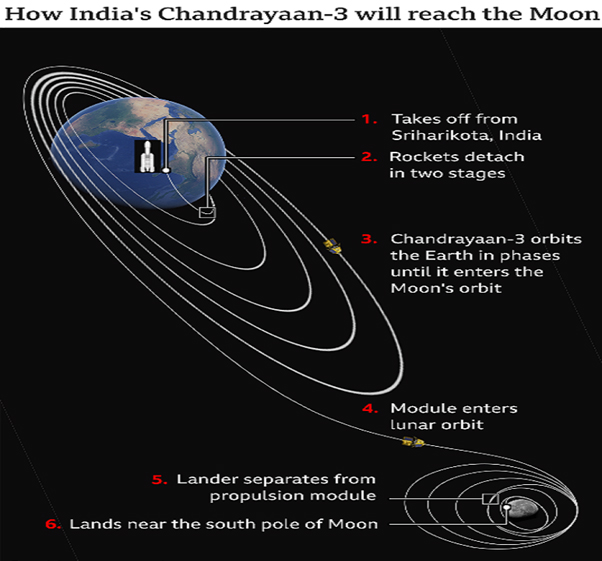
    The Chandrayaan-3 with its orbiter, lander and a rover lifted off from Sriharikota space centre.

    The lander will reach Moon on 23-24th August.

    India will be the fourth country to achieve a soft landing on the Moon, after the US, the former Soviet Union and China.

    Moon Missions

    The third in India’s programme of lunar exploration, Chandrayaan-3 is expected to build on the success of its earlier Moon missions. Chandrayaan-3 is a new chapter in India’s space odyssey

    India has a successful trail of Moon Missions in Chandrayan I and Chandrayan II

    Chandrayan I was launched in 2008 which carried the detailed search of Water on Lunar Surface and established that Moon has water on its surface

    Chandrayaan II was the next ambitious mission launched n July 2019  to land a rover on the lunar surface but the mission was partially successful. due to complications in the system. The rover could not land the moon, however the Chandrayan II Orbiter is still circling the moon.

    Chandrayaan III is the latest moon mission which is aiming to land on the moon, thereby making history with indigenously developed technology and becoming only the fourth country in the world to be able to achieve this distinction.

    India’s Pride

    The ambitious project is worth Rs 610Cr which weighs 3,900kg

    The moon lander is named Vikram after the legendary founder of ISRO, Vikram Sarabhai. The lander weighs about 1,500kg and it carries the moon rover Pragyaan, which means wisdom.

    Now after the spectacular lift-off the spacecraft will circle the earth for about 15 to 20 days and later enter the Moon’s orbit. On entering the lunar orbit, the speed of the spacecraft will be reduced for the soft landing of Vikram lander

    Moon Rover

    On soft landing the moon, the six-wheeled rover will roam the surface of the moon and send the images and crucial investigation data from the lunar surface. The Rover Pragyaan has five vital instruments to gather the data about the Physical characteristics of the Moons surface, its Atmosphere and the Geological Characteristics of Moon. The rover is a solar powered vehicle which will roam around the surface of the moon which is not visible from the earth..

    The orbiter from Chandrayaan II which is still successfully orbiting the moon, has been providing high-resolution images of the spot where Chandrayan III will land…

    The landing is aimed to be very precise and soft which will coincide with dawn of the lunar day…

    Aiming High

    Indian scientists are very keen to explore the South Pole of the moon, which is still unexplored fining out and reconfirming the earlier discovery of water in the south pole of the moon

    The scientists and people of India are waiting for the day to dawn as the Space Programe is a matter of pride for India…Moon will be the first step for Reaching to Stars… and after Chandrayan India has lot more to come in its ambitious Space Mission

    -Dr Siddhivinayak Barve

    Editor, ScienceNow Digital

  • Solar Energy : Empowering Civilisation

    Whether it be glass knives or arrowheads used in the Bronze Age or jewellery and tableware in late Bronze Age or inexpensive windowpanes and pottery in the Iron Age or exotic stained glass artwork used in Churches through the Middle Ages or transparent solar panels in the Modern times, breakthrough glass manufacturing technologies continue to ‘transform’ and ‘mould’ human civilisation,

    “Why pay hefty electric bill every month? Generate your own electricity at home.”

    Don’t be surprised if you happen to see this ad coming up shortly in any newspaper or digital media. Because harvesting solar energy directly from transparent glass windows, rooftops, building walls, smartphones, car roofs… is going to be soon possible. Heliatek GmbH, a German company, has developed partially transparent solar panels which absorbs 60% of the sunlight it receives, and converts it into electricity. The company claims that these panels achieve 7.2% energy efficiency as compared to 12% efficiency delivered by most conventional solar photovoltaic panels. As researchers continue to look for solutions to increase ‘energy efficiency’ and ‘transparency’ of these glass panels, what’s really exciting is the fact that transparent solar panels could soon be mass produced at the cost of regular glass sheets.

    If ever we begin to harness this ‘green energy’ on a large scale in the near future, it wouldn’t be the first time that the wonder substance ‘glass’ would have helped usher in a new revolutionary transformation. Looking back into history, one realises that centuries-after-centuries if there was one substance on earth that has ‘transformed’ and ‘moulded’ the growth and advancement of human civilisation, it was ‘glass’. Ever since mankind accidentally discovered glass some 3600 years ago in Mesopotamia (i.e. coastal north Syria) in the form of glass beads (i.e. a slag by-product during metal work), it has continued to amaze us all through its sheer ‘adaptability’ and ‘versatility’.

    In the Bronze Age…

    Since 30th century BC, the Egyptians obsession for glass led to some rapid growth in glassmaking technology. Coloured glass had grown into a craze and prized possession of the elite class were glass vessels, coloured and shaped glass items, hardglass carvings, ubiquitous beads, etc. This civilisation perfected the art of extracting glass from the ashes (i.e. soda ash) of many seashore plants. Several communities in Western Asia closely guarded their unique manufacturing techniques. Commonly used for production of knives, arrowheads, jewellery and money, by the 15th century BC, glass making grew into being an established industry across Western Asia and Egypt.

    In the late Bronze Age…

    It was around the 9th century (late Bronze Age), the technique of making colourless glass was discovered and craftsmen started using glass to make artistic tableware. By the 6th century the glass making industry started use of moulds for inlays to shape glass and the first glass making ‘manual’ known to mankind dates back to 650 BC.    

    In the Iron Age…

    Somewhere in the 4th – 5th century BC, a Roman merchant happened to rediscover a translucent liquid oozing out of the sand while preparing meals on the beach. This led to the discovery of a new manufacturing technique of producing glass using white silica sand. This new source of raw material led to development of the revolutionary ‘glass blowing’ manufacturing technique during the first century BC. Glass vessels were now inexpensive compared to pottery vessels, and it is said that glass became the Roman plastic being used by masses.

    In the Classic Middle Age…

    It was the Romans (around 100AD) who began to use glass for architectural purpose, and cast glass windows of poor opacity appeared in the most important buildings in Rome. Over the next 1000 years, glass making flourished in the Roman Empire and spread from Italy to all countries across Europe. Throughout Europe the churches and cathedral saw the fine art of making stained glass achieve miraculous height till about 14th Century. The first glass factory in the United States was built in Jamestown, Virginia in 1608.

    India was also at the forefront of the glass technology in South Asia since 16th Century. Indian artisans who were masters in glass moulding, decorating and colouring techniques, benefited tremendously from the new manufacturing techniques developed in Western Asia and Europe owing to its Greco-Roman connect.

    -Dr Siddhivinayak Barve

    Editor, ScienceNow Digital

  • Most Populous

    IT is a demographic Change… World has grown with assumption that the most Populous Country on the earth is China..Now the situation is different. The UN Report has brought to the fore that Now the most Populous country in the world is India….

    Too many

    India has overtaken China to become the most-populous country in the world. With 142.86 crore people, marginally ahead of China at 142.57 crore, India is on track to be the world’s most populous country.

    Acccording to UN World Population Prospects published in 2022, by 2050, India’s population would reach 166.8 crore, far exceeding China’s declining population at 131.7 crore.

    Population Surge

    If we take a look at the population surge In 1950, India was at 86.1 crore, while China was at 114.4 crore.

    India’s population is expected to grow further for the next three decades after which it will begin declining.

    According to the report, the average life expectancy at birth for males in India is 71 years while for females it is 74 years. India’s total fertility rate (births per woman in the reproductive age) is estimated at 2.0.

    The global population has touched 8 billion and according to the new UNFPA report, it is growing at its slowest rate since 1950, moreover it has fallen under 1 per cent in 2020.

    Blessing in disguise?

    According to the UNFPA’s State of World Population Report 2023, 68 per cent of India’s total population is between the ages of 15 and 64 years, which is considered the working population of a country. About 25 per cent is between 0-14 years; 18 per cent between 10 and 19 years, 26 percent between 10 and 24 years, and 7 per cent above 65 years.

    As the world reaches 8 billion people, India’s 1.4 billion people could be seen as as 1.4 billion opportunities, As India with the largest youth cohort, its 254 million youth in the age group of 15 to 24 years can be a source to reckon with.

    Concern

    India’s “population explosion” is certainly a cause of concern

    The growing population is indeed a cause of concern in terms of economic issues, environmental, Health and Education

    The most significant aspect about India’s population is the young and working population is larger than the population which needs care

    Population Boom

    The demographic shift is attributed to fertility rate which accounts to the rise and fall in the population India’s current fertility rate is 2 which has come down from over 3.4 in 90s

    The statistics shows that the rise in population is more in North than South India.

    The population is expected to grow before declining which is due to momentum of population

    India’s population is expected to peak by 2060

    Youngest Nation

    Indias workforce is expected to be around 1 billion, one in every eight of world population, is considered as an asset as a workforce of the world.

    Young English-speaking, digitally literate massive workforce is considered as a big resource, which can be realised by proper planning and policies to convert it into an opportunity

    The current average age of India is just 28 which is decade lesser than China

    Challenge

    IT is a two pronged war for India as India needs people who have the skills to fill some of the high-value jobs and an economy that produces these high-value jobs.

    Poverty should be addressed with utmost urgency, there are too many mouths to feed and the jobs should be made available for the working hands

    Most of the India’s population relies on Agriculture, the youth should be provided with the jobs in Industries or the Service Sector

    India Needs to strengthen the policies to convert the population as a Force

    With Over a Billion dreams and million aspirations… the population should be made an asset than the liability


    -Dr SiddhivinayakBarve

    Editor, ScienceNow Digital

  • CHAT GPT Challenge…

    The newest AI tool is posing challenge as to whether the tool will challenge human intellect.. will it affect the creativity… or replace the search engines.. Is it ethical and how much accurate…Explore…

    It is like a genie in hand… yes!

    Chat GPT is a latest conversational tool. Through the dialogue it is possible to get the answers of all your questions..

    Ask GPT about India’s Freedom Struggle and within seconds the India’s Freedom struggle is in your hand…

    Believe it… The New AI tool CHAT GPT gives human like answers…now it is questioned that whether the New Tool will challenge human talent and creativity

    What is It?

    Chat GPT is launched on 30th November last year developed by OpenAI

    Chat GPT is Chat Generative Pre-Trained Transformer… It is a Chatbot developed by OpenAI built on GPT family of large language models. ChatGPT is the latest step in OpenAI’s iterative deployment of increasingly safe and useful AI systems. ChatGPT is fine-tuned from a model in the GPT series  ChatGPT trained on an Azure AI supercomputing infrastructure.

    This model is developed using Reinforcement Learning from Human Feedback (RLHF). It incorporates the user and an AI assistant. This new dialogue dataset is mixed with the Instruct GPT dataset which is converted into a Dialogue format the CHAT GPT.

    New Tool

    This new tool is trained using huge digital database available online

    It mimics human conversation, it can compose music, tell stories, composes poems or write essays

    It incorporates new generation AI Systems which can strike dialogues and can reproduce stunning images, videos or presentations.

    During it’s research preview the CHATGPT model is initially offered Free

    Concern

    This AI tool is released just in November…  Considered as Future of AI and the direction it is going…  but there is huge uproar.. fearing it would take over human Intelligence or mar the creativity…

    Limitations

    Questions arises as to whether Chat GPT has limitations… is it reliable…

    ChatGPT has multiple limitations. Its uneven factual accuracy, however, has been identified as a significant drawback…

    CHAT GPT can generate the answers for all school led curricular questions but can it solve CAT or JEE papers is the questions… Considered as a challenge to teaching learning.. World over many schools are blocking Chat GPT network.. Many Schools world over are banning the use of ChatGPT… stating that the results generated by ChatGPT are not logical 

    Human or AI

    The quick and instant answers is perceived as threat to human creativity and critical thinking…

    There are other drawback which are coming forth as may be the wisdom of Chat GPT is powered by the existing web knowledge resources likely yield a lot of false positives and negatives… ChatGPT is said to lacks ethics and can’t currently rank sites for reliability, quality, or trustworthiness.

    The questions are even raised as to whether the ChatGPT will threaten the various search engines

    New Version

    It’s more stable version is just released

    The ChatGPT popularity is increasing day by day… it has crossed 100mn mark already… The tool works better when interfaced in English

    Even if in school or public the use of GPT is banned but people will still be able to access it through the personal networks

    There will  be many more chat bots to be launched

    The tool is new.. Welcome the New Technology… moving ahead…

    But whether it can take up and challenge human intellect is a big question


    Dr Siddhivinayak Barve

    Editor, ScienceNow Digital


  • Air Pollution – The Invisible Threat

    The new WHO guidelines on the permissible levels of particulate matter indicate that more than 90 per cent of the world’s population lived in areas that fall into the category of polluted zones…

    According to WHO’s World Global Ambient Air Quality Database, nine in 10 people on Earth breathe highly polluted air and around 70 lakh people die every year from exposure to polluted air The World Health Organisation (WHO) has lowered the bar of pollution levels from the earlier concentration of PM 2.5 of 25 micrograms per cubic metre to 15 micrograms. The existing norms of WHO, which worked as a yardstick for policy makers and governments battling air pollution, had been in place since the year 2005. But more than 90 percent of the world’s population lived in areas that did not meet the 2005 air quality guidelines and with more stringent guidelines in place now, the number is expected to go substantially beyond the 90 percent mark.

    The New Guidelines

    In a bid to push countries towards clean energy, WHO has tightened the air quality guidelines for the first time since 2005. Even at very low levels, research has shown “air pollution affects all parts of the body, from the brain to a growing baby in a mother’s womb,”. It is one of the biggest environmental threats to human health, alongside climate change. Improving air quality can enhance climate change mitigation efforts while reducing emissions that will, in turn, improve air quality.

    The organisation has revised air quality levels for six pollutants that include particulate matter (PM), ozone (O), nitrogen dioxide (NO) sulfur dioxide (SO) and carbon monoxide (CO). According to the new limits, average annual PM2.5 concentrations should be no higher than five micrograms per cubic meter.

    Scientists have determined that long-term exposure to concentrations even that low still contributed to heart and lung diseases, stroke and other negative health impacts. Announcing the new guidelines, the WHO said that “almost 80% of deaths related to PM2.5 could be avoided in the world if the current air pollution levels were reduced.”

    A Looming Catastrophe

    According to data from more than 3,000 cities compiled by the World Health Organisation (WHO), outdoor air pollution has grown 8% globally in the past five years, with billions of people around the world now exposed to dangerous air. The WHO said that disparities in air pollution exposure are increasing worldwide, particularly as low- and middle-income countries are experiencing growing levels of air pollution because of large-scale urbanization and economic development.

    The fact that nearly 90 per cent of the world population lived in areas that did not meet the air quality standards is definitely the sign of a looming catastrophe and India definitely features prominently in this red alert zone.

    Almost all of India is polluted!

    Significantly, in tune with the new WHO guidelines, almost all parts of India can be deemed polluted as the air quality levels are worse than the permissible limits prescribed by the WHO throughout the year.

    India recommends the concentration of PM2.5 of upto 60 micrograms per cubic metre over a 24-hour period for an area to be termed as pollution free in contrast to the 25 microgram limit set by the WHO 2005 guidelines. Even the lower standards set by the Indian government are flouted every year as several metropolitan cities report severe pollution in the run up to the winter months including Delhi, NCR, Mumbai, Kolkata, Gwalior among others.

    Indian cities dominate and stand on the worst ranks in a number of studies on air pollution. As per a Greenpeace study, the average concentration of PM2.5 was about 17 times higher in Delhi, eight times higher in Mumbai, nine times higher in Kolkata and over five times higher in Chennai than the recommended levels.

    The University of Chicago’s Air Quality Life Index (AQLI) report showed that India is the most polluted country in the world, with more than 480 million people or about 40 per cent of its population living in the Indo-Gangetic plains in the north where pollution levels regularly exceed those found anywhere else in the world by an order of magnitude. It has also been reported that the pollution levels have expanded geographically over time and increased so much in Maharashtra and Madhya Pradesh that an average person is now losing an additional 2.5 to 2.9 years of life expectancy.

    A Greenpeace report titled, ‘Behind the Smokescreen’ pointed that among the eight state capitals, Delhi had the worst breathable air with a massive spike of 125 per cent in Nitrogen Dioxide concentrations during April 2021 as compared to the corresponding month in 2020. While researchers took into account the weather changes, had it been more severe the pollution would have spiked by 146 per cent from 2020. This clearly indicates that human induced factors contribute exponentially to increase air pollution levels.

    We are responsible…

    In early 2020, NASA published satellite images which showed a dramatic decline in pollution levels over China, which the US space agency says was “partly related” to the coronavirus. This was the case across many countries in the world. Efforts to stem the spread of the coronavirus changed the ways people worked and conducted their lives. Though temporary, these changes have definitely led to curbing greenhouse gas emissions and improving air quality.

    Satellite readings in the troposphere (the lower atmosphere) of nitrogen dioxide (NO2), a pollutant primarily from burning fossil fuels, show a dramatic decline compared to early period when power plants were operating at normal levels. NASA Earth Observatory

    The same difference was evident during the 2008 summer Olympics in Beijing. To help improve the air, government officials had shut factories and dramatically limited car travel before and during the games leading to levels of some air pollutants dropped by half. This clearly points out to the fact that the high levels of pollution are due to mankind’s irresponsible behaviour towards the environment, restricted not only to a particular country or continent but across the global landscape.

    Air pollutants also contribute to climate change like heat waves, extreme weather changes, food supply disruptions, and other effects that can create havoc to the very existences of life on planet earth. Humans have pumped enough carbon dioxide into the atmosphere over the past 150 years to raise its levels higher than they have been for hundreds of thousands of years.

    Lakes around the world are freezing less and less over time, and in a few decades, thousands of lakes around the world may lose their winter ice cover entirely. The Amazon is losing the equivalent of nearly one million soccer fields of forest cover each year, much of which is cut down to make way for agriculture.

    When forest is lost, the carbon it seized ends up in the atmosphere, accelerating but across the global landscape. Air pollutants also contribute to climate change like heat waves, extreme weather changes, food supply disruptions, and other effects that can create havoc to the very existences of life on planet earth.

    This implies that in all ways, governments around the world must take bold action to ensure their cities and communities turn from sources of air pollution related health risks to safe places for billions of humans to reside.

    Clean the Air now or …

    The WHO’s updated Air Quality Guidelines are a firm warning about the severity of our air pollution crisis. The need of the hour is for governments across the world to adopt WHO Air Quality Guidelines, which are based on the latest scientific understanding and seek alternatives to burning fossil fuels for power, transport and industry.

    What if…and hear me out…

    what if the entire human population used this opportunity to restart society on a greener, more environment conscious foot…?” Yes, the time to begin is NOW

    -Dr Siddhivinayak Barve

    Editor, ScienceNow

  • The Comet Cometh…

    A bright green comet is set to pass by Earth’s outer space for the first time in 50,000 years…

    The celestial visitor was first spotted in March 2022 while it was inside the orbit of Jupiter.
    The comet will appear like a faint, greenish object in the sky and if it is viewed through the telescope the tail of the comet will be seen. This celestial object, according to NASA it is making its closest approach to earth on 2 February, just around 42 million Km

    Discovery

    On March 2, 2022 astronomers Frank Masci and Bryce Bolin using the Zwicky Transient Facility (ZTF) at the Palomar Observatory in Southern California, came across an object which they initially identified as an asteroid.

    It appeared very dim nearly 25,000 times fainter than stars that the human eye can detect. Later it was revealed that this star-like object possessed a very tightly condensed coma, indicating that it was a comet. At the time, the comet was situated 643 million km from the Sun, just inside the orbit of the planet Jupiter.

    Structure

    Comets are composed primarily of frozen gases that are heated as they approach the sun and glow by the sun’s light, this cloud of gas is the head or coma of the comet. As the gases warm and expand, particles of dust that are released into space forming the tail of the Comet

    Comets generally throw off two types of tails; tails composed primarily of gas, and tails composed primarily of dust. Dust tails are far brighter and more spectacular to the eye than gas tails

    This comet is made of ice and dust and emits a greenish aura, with a kilometre-wide diameter will be visible to the naked eye, prior to this comet Neowise was spotted in March 2020 and the grand Hale-Bopp comet in 1997

    This comet is believed to have come from the Oort Cloud, a theorised vast sphere surrounding the solar system that is home to mysterious icy objects. The last time this comet passed Earth was during the Upper Paleolithic period, when Neanderthals still roamed Earth.

    Rare Opportunity

    The comet is estimated to have an orbital period of roughly 50,000 years. Its last passage through the inner solar system apparently came during the Upper Paleolithic or Old Stone Age. It means that if at all it was spotted by anybody from the earth, it would be the Neanderthals

    The special fact about this comet is that, it has a parabolic orbit which means that the chances of its return are very rare or never again… which makes it more significant to see this comet perhaps for the first and last time….

    The best opportunity to locate the comet in the sky will be on 9-10 Feb, when it passes close to Mars however will depend on a variety of factors including location and light pollution from both natural and artificial sources

    A close study of this rare visitor may give the information about our solar system well beyond most of the distant planets.

    -Dr Siddhivinayak Barve
    Editor, ScienceNow Digital
  • IYoM : SUPERFOOD Millets

    United Nations General Assembly has declared the year 2023 as the International Year of Millet. The U.N. Food and Agriculture Organization has endorsed India’s proposal to declare 2023 as the International Year of Millets…

    Initiative

    In 2018 the government of India decided to mark the National Year of Millets. In the same year, the government also notified millets as nutri-cereals and included them under the POSHAN Mission Abhiyan.

    India pitched the proposal to United Nations for declaring 2023 as the International Year of Millets. India’s initiative to promote millet was recognized and United Nations General Assembly has declared the year 2023 as the International Year of Millets.

    Milletts

    Millet, a grain mainly grown and consumed in developing countries until recently and once considered a poor man’s staple, is quickly becoming a favourite globally among those affected by climate change because of its ability to thrive in harsh and arid environments. Its drought-resistant quality makes it attractive as many parts of the world begin to experience a water supply shortage.

    It is a proud moment for Indian farmers as India is the largest producer of Millets in the world accounting for 20 % of global production and 80 % of Asia’s production.

    The aim for 2023 is to increase awareness about Millet in food security and nutrition and also to encourage investments in research and development

    Superfood 

    Millets have been an integral part of our diet for centuries. In addition to a plethora of health benefits, millets are also good for the environment with low water & input requirement.

    Millets are called the super grain because of their high nutritional value. According to the Food Safety and Standards Authority of India (FSSAI) millets are high in dietary fibre. Specifically, millet contains 7-12 % protein, 2-5 % fat, 65-75% carbohydrates and 15-20% dietary fibre. Due to their high density of nutrients including vitamins, minerals, phytochemicals and dietary fibre, millets are also excellent grains to alleviate malnutrition and micronutrient deficiency. Additionally, millets do not require high-quality soil to grow and hence can easily cater to the need of the growing population.

    The nutritional value of millets makes it even more relevant globally in the aftermath of the COVID-19 pandemic.

    Prospects

    2023 will provide an opportunity to increase global production, efficient processing and better use of crop rotation and promote millets as a major component of the food basket

    Asia and Africa are the primary production and consumption centres of millet crops. India, Niger, Sudan and Nigeria are the primary producers of millet.

    Organizations like the International Crop Research Institute for Semi-Arid Tropics (ICRISAT), are investing in and developing a strand of Pearl Millet with greater resistance to drought and disease to address climate change and the myriad of new challenges it is presenting.

    In addition to millet’s attractive growth characteristics, it is one of the most nutritious and anti-allergenic grains available. Millet is gluten-free, making it an excellent choice for the millions of people around the world who suffer from Celiac disease or have a gluten sensitivity. It is high in B vitamins, calcium, iron, potassium, zinc, magnesium, and fats. And it’s an excellent source of protein and dietary fiber.

    Millet production is projected to sharply increase due to its many health benefits and ability to grow in a variety of climates. In India and Africa can be high-iron pearl millet superfood to combat malnutrition. Millets can play a key role in achieving that objective, and it is hoped that by declaring 2023 as the International Year of Millets, more attention will be paid to this important grain. India has an opportunity to lead the world towards Superfood.

    Dr Siddhivinayak Barve

    Editor, ScienceNow Digital


  • NOBEL ‘22

    NOBEL ‘22

    The Nobel Prizes are five separate prizes awarded as per the will of Alfred Nobel to those who have conferred the greatest benefit to humankind. 

    Alfred Nobel was a Swedish Chemist, Engineer, and Industrialist most famously known for the invention of Dynamite. He died in 1896. In his will, he bequeathed all of his assets to be used to establish five prizes which became known as “Nobel Prizes.” Nobel Prizes were first awarded in 1901.

    Nobel Prizes are awarded in the fields of Physics, Chemistry, Physiology or Medicine, Literature, and Peace. In 1968, Sweden’s Central Bank funded the establishment of the Prize in Economic Sciences in Memory of Alfred Nobel….

    Nobel Prizes ‘22

    The Royal Swedish Academy of Sciences announced 2022 Nobel Prizes. 

    Nobel Prize, one of the world’s top honours, has been declared for the year 2022 in designated Science categories such as Medicine, Physics and Chemistry.

    The announcement of Nobel Prize winners is one of the most awaited moments for people associated with fields ranging from Literature to Science, here is a look at this year’s winners…

    Nobel-Physiology and Medicine:

    The Nobel Prize 2022 in Physiology and Medicine is awarded for discoveries concerning the genomes of extinct hominins and human evolution.

    The Nobel laureate has established an entirely new scientific discipline called Paleogenomics. The discoveries revealed genetic differences that distinguish all living humans from extinct hominins, and provide the basis for exploring what makes us uniquely human.

    The Nobel Prize for Physiology and Medicine 2022 is awarded to Svante Paabo for his discoveries concerning the genomes of extinct hominins and human evolution”

    Nobel-Physics:

    Nobel Prize in Physics is jointly shared for experiments with entangled photons, establishing the violation of Bell inequalities and pioneering quantum information science. 

    The Nobel laureates have conducted ground breaking experiments using entangled quantum states, where two particles behave like a single unit even when they are separated. 

    The Nobel Prize for Physics 2022 is awarded jointly to three sicientists, Alain Aspect for experiments with entangled photons, establishing the violation of Bell inequalities and pioneering quantum information science, John Caluser for experiments with entangled photons, establishing the violation of Bell inequalities and pioneering quantum information science and Anton Zeilinger for experiments with entangled photons, establishing the violation of Bell inequalities and pioneering quantum information science”

    Nobel-Chemistry:

    The Nobel Prize 2022 in Chemistry is awarded for the development of Click Chemistry and Bioorthogonal Chemistry. The Nobel laureates had worked on click chemistry and bioorthogonal reactions. Click chemistry is utilised in the development of pharmaceuticals, for mapping DNA and creating materials that are more fit for purpose, while bioorthogonal reactions have helped researchers improve the targeting of cancer pharmaceuticals.

    The Nobel Prize for Chemistry 2022 is awarded jointly to Carolyn Bertozzi for the development of click chemistry and bioorthogonal chemistry, Morten Meldal for the development of click chemistry and bioorthogonal chemistry and K Barry Sharpless for the development of click chemistry and bioorthogonal chemistry.

    The Nobel Foundation has announced that laureates will receive their prize medals in Stockholm in December after Covid induced interruption of two years. Winners from 2020 and 2021 will also be invited to attend the ceremony. 

    Dr Siddhivinayak Barve

    Editor, ScienceNow Digital

  • Cover Story Future is Here…5G Revolution…

    Breath-taking Speed… Even before you think it is done…. Now 5G is here… to change the world for better. Launched in India by Prime Minister Narendra Modi on 1st October at India Mobile Congress in New Delhi…It is a game-changer Technology…Connecting People and bringing the world closer…

    learn what 5G is and how it will deliver…

    This is 5 G.. yes, it represents the fifth generation of mobile network technology… 5G is an innovation platform… It will entirely change what we can do with mobile connectivity…5G is so much more than just another ‘G’, which will only be limited by imagination. Now India is 5G Ready and the 5G network will unfold in the country in coming months… So Get ready to for a revolutionary change in the business and society…

    How 5G Different…

    Till today we are using mobile networks for voice and messaging, web-browsing and data and video streaming. The new transition with 5G will benefit both consumers and businesses. 5G will see billions of connected devices gather and share information in real-time, transforming the world, creating more opportunities for everyone.

    Almost everything will experience transformation, with the capability of sharing large volumes of data in literally in split second time, with lag free network making the data processing and storage more efficient. The new 5G network will be 100 times faster…

    Imagine India with limitless connectivity which will definitely open up limitless possibilities. Connectivity will enable an exciting future, and a stronger Digital India.

    Network

    Existing 2G, 3G and 4G networks primarily use radio focused technologies, 5G deploys combo with radio, a telecom core, and an operation system. This process will involve cloud-based core, incorporating new concept technologies like network slicing. 5G networks uses low, mid and high radio frequencies. 5G networking technologies will provide wireless connectivity to the devices.

    All in One Technology..

    5G will open up huge opportunities with tremendous Societal Benefits, especially for our country. It will help Education, Health and Industrial Transformation. The capabilities of the technology are real and 5G is here and ready to be deployed.

    Benefits

    5G is by far the most energy efficient of all the generations of mobile technologies. The emerging 5G and IoT will revolutionise the world and even will lead to reduction in global emissions and help in combatting climate change, which will ultimately support a sustainable future for everyone

    Limitless Possibilities

    When technology connects, extraordinary things become a reality. The 5G Technology will help reaching and educating remotely placed students across India. Digital labs will help learners to gain the skills, leveraging ICT to enhance learning outcomes.

    Limitless connectivity will help transform India’s industries for the better. 5G Technology enabled smart businesses can gain massive benefits in terms of sustainability, productivity as well as efficiency. Smart enterprises powered by the next generation network will be a key economic multiplier realizing the true ‘Digital India’.

    The 5G connectivity can usher a new era of remote healthcare platform, enabling healthcare professionals to carry out remote diagnostics on patients from remote rural location. 5G technology will also enable access to healthcare in remotest parts of the country.

    5G Technology will a game-changer in unleashing new dimensions in sports and entertainment sectors, which will enable a new era, which will be more interactive, available anytime, anywhere.

    The 5 G Technology will in real sense open the Digital Economy to all, leading to commercial and social benefits. The 5G Technology will provide easy access to financial services.

    Thus the future is here… 5G will be socio-economic multiplier for the country, realising the dream of Digital India.

    Dr Siddhi Barve

    ScienceNow Digital

  • ‘Hap-Pea’ Birthday Mendel @ 200

    Tribute to the Man who discovered the Laws of Heredity. He performed experiments on Peas which brought him fame and laid the foundation a new discipline of science known as modern day Genetics… Rightly described as the ‘Father of Genetics,’ this ‘Hap-Pea’ man, Gregor John Mandel’s Birth Bicentenary is celebrated world over….


    Early Days


    The genius, Gregor John Mendel, born on July 20, 1822 in a German-speaking family that lived and worked on the family farm for generations which is now in the Czech Republic. During his childhood, Mendel worked as a gardener and studied beekeeping.


    Mendel loved his family very much and was grateful to them. He had a special emotional relationship with his family, and especially with his mother, He addresses his parents as ‘Dearest Parents’ or ‘Beloved Parents’, and his mother and sister as ‘Dearest Mother, Dearest Sister’.


    Mendel became a priest and from 1868 the Abbot of the Augustinian Abbey in Brno, which supported Science and provided the necessary facilities to Mendel. He became a Monk in part because it enabled him to obtain free education. After becoming a Monk, Mendel spent most of his life in the Augustinian Abbey of St Thomas in Brno. It was in this Monastery, he conducted his crossbreeding experiments with Pea plants, through which he discovered the role of Dominant and Recessive genes. This discovery later formed the core of Genetics, one of the most important sciences of the 20th century.


    Pea Experiments


    Mendel conducted very simple hybridisation experiments on over 5000 Pea plants which he had planted in the garden of his monastery at Brno. When Mendel planned his experiments with peas, he first studied the conclusions of his predecessors, who had undertaken similar experiments with plant crosses. He was aware that this would be a difficult task. He studied seven different characteristics of Pea Plants, including Height, Pod shape and Seed colour. Mendel showed that when two differently coloured Pea plants were cross-bred, their offspring always produced seeds of only one colour, but in the next generation he observed that the other colour reappeared in the ratio of one to three. Mendel coined the terms ‘Dominant’ and ‘Recessive’ for the different traits he observed in Pea plants. During ten years of experimentation on Peas, Mendel grew over 28,000 Pea plants and made conclusions on the different ratios he obtained that are now known as Mendel’s laws of heredity.


    The Genius


    Gregor Mendel (1822–1884) is regarded as the father of Genetics owing to his meticulous research on the common garden Pea (Pisum sativum) that allowed him to deduce fundamental laws of inheritance. His discovery of the laws of genetics were far ahead of his times. His insights were developed long before we understood the structure of DNA and the genes that constitute Mendel’s inheritance “factors.”


    The genius of Mendel’s contribution to science revelled the secrets of evolution. The two greats, Mendel and Darwin never met, but the theories proposed by Mendel proved to be complementary to the theory of evolution. Mendel’s work is not merely restricted in helping reveal the evolutionary mechanisms but his multidisciplinary approach is fascinating. Mendel achieved an unprecedented interconnection between theory and practice by using methods unknown to biological science of that time. He was one of the first to apply mathematical methods to biological research. His painstaking analyses of seven carefully selected traits assessed in approximately 28,000 Pea plants over the course of a decade allowed him to discover the fundamental laws of inheritance .


    Mendel published his work describing the actions of invisible ‘factors’ in determining the traits of an organism, these factors are now known as ‘genes’.


    Late Recognition


    When Mendel presented the results of his experiments in 1865, he received a little response. The world, which was overwhelmed by Darwin’s theory of evolution, did not understand Mendel’s work and its significance. The significance of Mendel’s work was not recognised until more than three decades later, with the rediscovery of his laws of inheritance Mendel gained posthumous recognition as the founder of science of Genetics. Mendel’s Pea plant experiments, conducted between 1856 and 1863, established many of the rules of heredity, now referred to as the laws of Mendelian Genetics. Mendel’s importance was rediscovered 16 years after his death, when his conclusions were confirmed by Erich von Tschermak, Hugo de Vries and Carl Correns while independently verifying Mendel’s experimental findings in 1900. This heralded a new era in modern age of genetics which earned him the title of “father of genetics”.


    Versatile Genius


    Gregor Johann Mendel A modest genius was an extraordinary versatile personality. He was a biologist, meteorologist and a mathematician too,


    Mendel enjoyed beekeeping since his very childhood. He invented new ways of overwintering of bees and he also tried the cross-bedding of bees. He was an outstanding pomologist. He cultivated vines and new species of fruit trees and regularly participated in competitions.


    Mendel was also fond of Meteorology. He was one of the Pioneers of Weather forecasting. Mendel made daily meteorological observations three times a day, at various sites of the Monastery, he carried out measurements for the Meteorological Institute in Vienna and kept the records of them.


    Mendel was also an excellent teacher. He taught Physics at a Secondary School in Brno, where he presented the results of his observations on inheritance in 1865. Mendel also wrote poetry and in one of his poems titled ‘The Man’ his life credo is described that ‘It is man’s destiny to strive for high goals and to use all his abilities to achieve them’.


    The great genius, the ‘Pea Man’ died on 6th Jan 1884, revealing the Laws of Heredity and giving birth to the Science of Genetics.


    Dr Siddhivinayak Barve
