
What If?
Ocean Currents Stand Still?
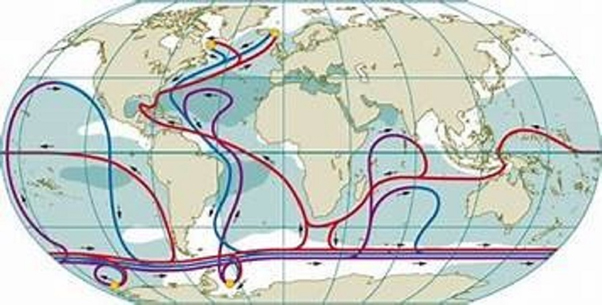
Ocean currents play a significant role in controlling climate around the globe. These currents act like a giant conveyor belt, warming and cooling parts of the Earth as water circulates. Melting ice caps, which can happen due to global warming, can cause ocean waters to circulate and have a drastic effect on climate…
What are Ocean Currents?
Around the world, there are a number of ocean currents which have a serious impact on climate. For instance: The Gulf Stream in the Atlantic transports warm water with a high level of salinity and low density from equatorial regions further north on the ocean’s surface, warming countries such as the United Kingdom. The further north the water travels, the cooler it gets. Cold water becomes denser, falls further towards the bottom of the ocean and is carried back further south. This causes a continual ocean current in the North Atlantic.
Global Warming
Polar ice caps are beginning to melt due to global warming. Since ice caps are composed of freshwater, and if they continue to melt, it would bring down the level of salinity in the surrounding ocean waters. Changes in salinity levels could affect thermohaline currents by preventing water from achieving enough density to sink to the bottom of the ocean. More seriously, ocean currents could stop completely.
Effects of Ocean Currents
If ocean currents were to stop, climate could change drastically, especially in Europe and countries in the North Atlantic. In these countries, temperatures would drop, affecting humans as well as plants and animals. In turn, economies could also be affected, particularly those that involve agriculture. If these effects were to continue, Europe, North Atlantic countries and parts of North America could experience long periods of freezing conditions. Also, if ocean currents stopped because of climate change it will have many other affects associated with the global-warming phenomenon.
Earlier Phenomena
Earlier evidence of rocks and ice have shown that ocean currents have indeed stopped for periods of time in history. One example can be found around 13,000 years ago when the warmth experienced at end of an ice age caused large masses of ice to melt into the sea. The resulting changes in water density stopped ocean currents from flowing and caused freezing conditions in some parts of the world for over 1,000 years.
Noel Fernandes
-Team ScienceNow Digital
