
Agri Tech
Farming Drones
For centuries, India’s agriculture-based economy has been predominantly driven by farmers who toiled hard to feed themselves and society. Fighting against all odds – unpredictable rains, depleting water sources, changing climate, depleting soil condition, pest attacks… staking their meagre fortune, they always remained hopeful of a bountiful harvest. Living in abject poverty and straddled with generations-old farming techniques, they continued to be susceptible, ill-prepared and ill-equipped in the face of the emerging challenges. Often at the mercy of nature and completely dependent on the benevolent rain God, they continued their eternal struggle to break-free from the stifling noose of poverty and starvation….
Over the last 3-4 decades, dwindling farm income has forced several farmers to seek employment in industries in some urban locale. As for those farmers who stayed back in their villages, they had to adopt/adapt to technology-intensive farming taking real-time actions based on real-time soil/crop information. ‘Modern’ or ‘precision’ farming methods are gradually transforming how agriculture is done, thereby leading to improved crop yields, better land utilisation and resources management, and also optimisation of time and finances.
Of the several tech-gadgets presently being deployed in precision farming to collect data and initiate timely actions, the drone technology is fast emerging as the new favourite. Let’s look at how drone technology is transforming agriculture practices in the country:
Drones in Agriculture
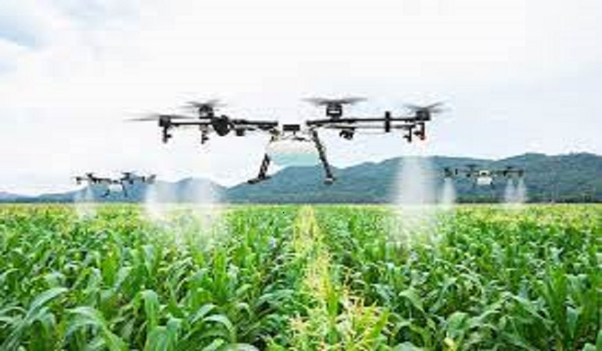
On a day-to-day basis, a farmer is required to be watchful of a variety of factors that influence the success of his farm. Whether it be: timely watering of plants or adding fertilisers to soil or promptly responding to climatic changes or maintaining of soil health or tackling of weed and insect problems, etc., farmers are resorting to use of high-tech drone technology. Drones equipped with a wide range of technologies like propulsion systems, infrared cameras, GPS and navigation systems, programmable controllers, automated flight planning… are now providing fast and efficient solutions to farmers. In short, the use of drones in agriculture is helping farmers meet the changing and growing demands of the future. Here are some of the critical areas where drones are being popularly used:
- Soil and Field Analysis: Using drone technology, it is now possible for farmers to collect useful soil data at the beginning, middle, and end of crop cycle. Using 3D maps of soil, farmers would be able to check issues concerning soil quality, nutrient management and identify soil dead zones. This information is helping farmers to not only optimally use water resources, but also effectively manage crop nutrient levels.
- Seed Planting: It’s a relatively new agriculture area of application, but some companies and research institutions have successfully used drones for planting seeds over large geographic areas. Minimising the need for on-the-ground planting, drones have been used to shoot seed pods into prepared soil, in the process helping to save on cost, time and long strenuous work.
- Crop Spraying and Spot Spraying: In order to maintain high yields, often crops are required to be sprayed with nutrients after short intervals. Traditionally, it was done manually involving huge labour force or mechanically using costly hi-tech machines, which only added to the overall farm costs. Drones are now being used to spray fertilizers, herbicides or pesticides, and they are working out to be much safer and cost-effective. Now, it is also possible to identify specific problem zones in the farm and undertake spot spraying using drones in less time, with reduced finances and negligible damage to the environment.
- Crop Mapping and Surveying: One of the biggest advantages of using drone technology is the ease and effectiveness of monitoring crops aerially over large expanses. Using drone mapping and surveying technology, it is now possible to get real-time data of the crop using real-time visual footage. With Near Infrared drone sensors, the farmer can now actually understand the plant health based upon light absorption, thereby getting a bird’s eye view of the overall farm health.
- Irrigation Monitoring and Management: Irrigation of vast farmland is a tricky business, especially when the farmer has to water miles and miles of standing crop. Drones equipped with thermal cameras are now able to spot areas in the farm with irrigation issues – receiving too little or excessive moisture. Using this information, the farmer will be able to take timely measures – maximise drainage, adhere to natural land runoff, avoid water pooling, etc. so as to prevent damage to sensitive crops. With drone surveying, these issues can now be spotted in real-time before they become troublesome.
- Real-time Livestock Monitoring: It is now possible for farmers to keep track of livestock at regular intervals, using less farm labour and making optimal use of time. Drones are being used to closely monitor the animal herd and see if there are injured or missing livestock, as well as see which animal is likely to give birth to young ones. Thermal imaging now helps farmers to keep an eye on the livestock predators, and track abnormal herd movements.
While there is so much happening in agriculture drone technology, yet it is believed that the work is still in its infancy. As drones continue to maximise yields, minimise costs and future-proof farms, the biggest limiting factor to the growth of fields is the lack of trained pilots. With safety guidelines, drone best practices, insurance policies, drone camera and sensor technologies continuing to evolve and improve, the application of drones at the hands of highly-trained pilots is likely to revolutionise agriculture practices in the country.
-Manoj Mahanta
Team, ScienceNow Digital
