
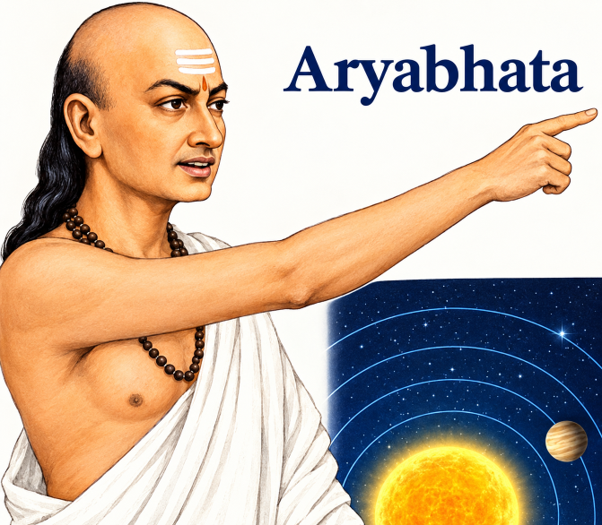
India has been the cradle of many scientific discoveries. Here we profile an Indian scientist and one ancient Indian technology
Aryabhatta was the first mathematician astronomer from the classical age of India. His works in mathematics and astronomy have been extensively used by the Greeks and others in the Middle East. His most famous work ‘Ayrabhatiya’ covering several branches of mathematics such as algebra, arithmetic, plane and spherical trigonometry was compiled when he was just 23 years old.
He was the first mathematician to give what later came to be known as the tables of sine, cosine, versine, and converse sine to four decimal spots, which brought forth trigonometry. Aryabhatta has named the initial 10 decimal places and derived the methods for extracting square roots and summing the arithmetic series. But it was his work on the place value system and discovery of zero that was of utmost significance.
In Astronomy, he discovered the position of nine planets, provided the circumference and measurement of the Earth, pronounced that the moon has no light of its own and concluded that the earth is round and that it rotates on its own axis thus causing days and nights. He also made predictions about the solar and lunar eclipses, duration of the day as well as the distance between the Earth and the Moon. India’s first indigenous satellite was named after this legend.