
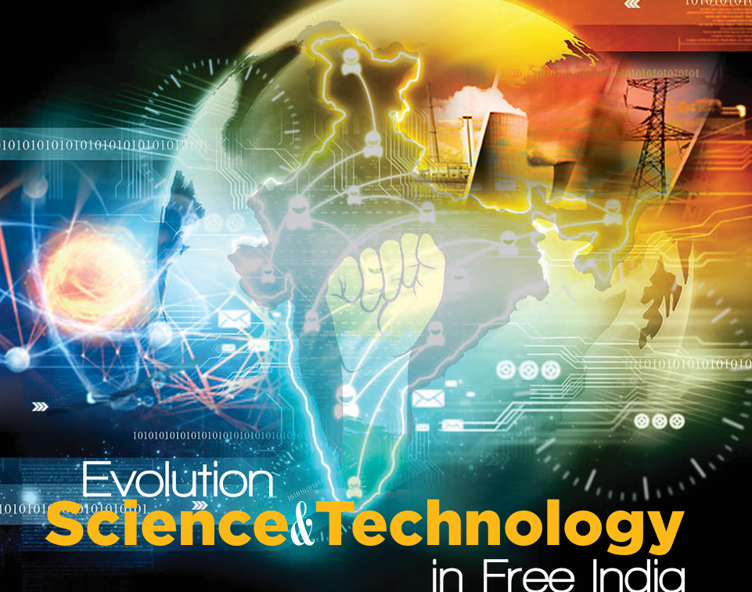
As India celebrates 80 years of Independence, we encapsulate some defining moments of the nation’s journey in the field of science and technology
Today, eighty years after India’s independence, the country is considered as one of the top five superpowers on the planet, with Indian scientists contributing enormously to facilitating the country’s rapid development and progress.
While it was the Prime Minister. Pandit Jawaharlal Nehru who initiated several reforms in higher education and set up pioneering science and technology institutions like TIFR, DRDO, BARC, IITs, DST… the policies of subsequent governments ensured that we continued to stay on the growth and development track. The present-day government under Prime Minister Narendra Modi is giving significant emphasis to creation of an ‘Atmanirbhar Bharat’ focusing on creation of a strong indigenous R&D and manufacturing infrastructure across the country.
Let’s look back in history at some of the major milestones achieved by the country in the area of science and technology:
1945: Tata Institute of Fundamental Research (TIFR) –
Dr. Homi Jehangir Bhabha asked Sir Dorabji Tata Trust for help and cooperation to begin nuclear research program in India. In 1945, Tata Institute of Fundamental Research (TIFR) was born, and thus started India’s journey in the world of nuclear energy development.
1954: India’s first Atomic Establishment at Trombay –
Under the leadership of Dr. Homi Bhabha, the Atomic Energy Establishment, Trombay (AEET) was established in 1954. Later, the institution was renamed as BARC in 1967 to help consolidate all research and technology activities. Today, BARC is India’s premier research and development facility in nuclear science and engineering, giving the country a strategic edge in nuclear power.
1956: India’s first atomic reactor ‘Apsara’-
This first nuclear reactor was designed by BARC and built with assistance from United Kingdom. Apsara is a light water swimming pool-type reactor with a maximum power output of one megawatt thermal (MWt), and it first went critical on August 4, 1956. The reactor is utilised for various experiments including neutron activation analysis, radiation damage studies, forensic research, neutron radiology, and shielding experiments.
1958: Formation of Defence Research and Development Organisation –
DRDO was formed in 1958 from the amalgamation of the then already functioning Technical Development Establishment (TEDs) of the Indian Army and the Directorate of Technical Development & Production (DTDP) with the Defence Science Organisation (DSO). It has a network of laboratories engaged in developing defence technologies covering various fields like aeronautics, armaments, electronics, land combat engineering, life science, materials, missiles and naval systems.
1959: Launch of Television –
Television was introduced in India on September 15, 1959 in Delhi, and the programs were broadcasted twice a week for an hour a day. Initially, the topics covered were community health, citizen’s duties and rights, and traffic and road sense, but in 1961 the broadcasts were expanded to include school educational television project. The first major expansion began in 1972, when a second television station was opened in Bombay, and it was followed by stations in Srinagar, Amritsar, Calcutta, Madras and Lucknow.
1964: The first Indian Jet Trainer –
The two seat intermediate jet trainer HAL HJT-16 Kiran (Ray of Light) were built by Hindustan Aeronautics Limited (HAL) on September 4, 1964. The jet called Kiran-I was powered by the Rolls
Royce Viper Mk 11 delivered to the Indian Air Force in March 1968. Later the trainer jet was upgraded with hardpoints under each wing for weapon training and redesignated as the Kiran-IA.
1969: Indian Space Research Organisation (ISRO) –
Established in 1969, ISRO is India’s pioneer space exploration agency with a vision to develop and harness space technology in national development. Over the years, ISRO has gained place among the elite space agencies in the world owing to its unique and cost-effective technologies. Recently, it conducted several remarkable space probes like Chandrayaan – 1 lunar orbiter, Mars Orbiter Mission (Mangalyaan – 1) and ASTROSAT space observatory. 1
1974: Pokhran –
India’s first successful Nuclear Test – After Indira Gandhi had authorised scientists at BARC to design nuclear device in September 1972, it took nearly two-years of preparation to conduct the first nuclear test. Code named ‘Smiling Buddha’ the test was conducted on May 18, 1974 in the deserts of Pokhran, Rajasthan. This made India the world’s sixth nuclear power country.
1975: Launch of Aryabhata –
Named after the ancient Indian astronomer – Aryabhata, the country launched its first satellite into space on April 19, 1975. The satellite was constructed by the Indian Space Research Organisation (ISRO) and was launched into space aboard a Kosmos-3M launch vehicle from Kapustin Yar, the then Soviet Union’s rocket launch and development site
1978: India’s first test-tube baby –
On October 3, 1978, Ms. Bela Agrawal delivered India’s first test-tube baby under the medical care and supervision of Dr. Subhash Mukhopadhyay. The child later named ‘Durga’ was conceived via in-vitro fertilisation, and the event took place just 67 days after the world’s first test-tube baby – Marie Brown, was born
1982: Launch of India’s first Satellite –
Insat 1A was a multi-purpose satellite system designed to provide two high power TV broadcast and twelve telecommunications national coverage transponders, in addition to providing meteorological services. The Insat-1A was launched by a Delta 3910 launch vehicle on April 10, 1982 but was abandoned on September 6, 1983 when its attitude control propellant was exhausted.
1983: Research base at the South Pole –
The country established its first scientific base station in Antarctica named Dakshin Gangotri. The station was built in record time of eight weeks by an 81-member team, and was powered by solar energy. The base was used to conduct scientific tests on radio transmission, physical oceanography, chemical analyse of freshwater lakes in the areas, geomagnetism, geology and glaciology.
1984: First Indian in Space –
The Indian Air Force Squadron Leader Rakesh Sharma spent eight days aboard the Salyut 7 space station along with two Soviet Cosmonauts. They had departed on April 2, 1984 in a Soyuz T-11 spacecraft. This manned mission saw Sharma conduct several scientific and technical studies in the area of biomedicine, remote sensing and construction of hydro-electric power station in the Himalayas.
1988: Launch of C-DAC –
In 1987, when US President Ronald Reagan refused to sell their supercomputers CRAY, India decided to develop it indigenously. In 1988, the Centre for Development of Advanced Computing or C-DAC was launched under the leadership of Dr. Vijay Bhatkar. With a deadline of three years and a budget of around Rs. 30 crore, India’s first super computer PARAM 800 was developed in 1991.
1991: DNA Finger Printing –
During his study of evolution of sex chromosomes in a species of snake, Dr. Lalji Singh observed and recorded specific pattern in the DNA sequences, which he named the ‘Bkm sequences’. He made use of this technique to identify people based on specific characteristic of their DNA, and was able to solve several court cases over disputed paternity and criminal cases. He pioneered the concept of ‘DNA fingerprinting’ in India.
1993: Launch of Pentium Chip –
Vinod Dham is popularly known as the ‘Father of the Pentium Chip’ for his contribution to the development of highly successful Pentium processors from Intel. Responding to consumer’s demand of computers with faster processing speed, Intel changed the game with the launch of its breakthrough chip – the Pentium.
1994: India’s first heart transplant surgery –
On August 3, 1994 a team of 20 surgeons led by Dr. Panangipalli Venugopal performed India’s first successful human to human heart transplant at the All Indian Institute of Medical Sciences (AIIMS), New Delhi. The entire operation took nearly 59 minutes and the patient lived for at least 15 more years.
1998: Pokhran – II –
Operation Shakti stunned the world community as India conducted a series of five nuclear tests – one fusion or thermonuclear weapon, two fission devices and two sub-kiloton devices, which proved to the world India’s capability in development of nuclear arsenal. Pokhran – II was the first Indian test of a nuclear weapon after 1974.
2000: Launch of indigenous fighter jet –
Tejas, the single seat, single-engine, lightweight, high-agility supersonic fi ghter aircraft made its first maiden test flight aboard Indian Navy’s aircraft carrier INS Vikramaditya in January 2000. The aircraft’s design and development program was led by Aeronautical Development Agency (ADA) under the supervision of Hindustan Aeronautical Limited (HAL).
2002: The Simputer –
A low-cost alternative to conventional computers, the Simputer was a self-contained, open hardware Linux-based handheld computer. It was devised to bridge the digital divide, but it did not succeed in taking off. Launched in 2002, it was the brainchild of seven scientists from the Indian Institute of Science, and was led by Dr. Swami Manohar. While it did not succeed, it remains an important homegrown development in computer manufacturing.
2003: Kalpana Chawla space disaster –
Kalpana Chawla, was the first Indian-origin woman to go space on a 16-day mission aboard NASA space shuttle Columbia. On the morning of February 1, 2003, the space shuttle was to return to Earth. At the time of launch, a briefcase-sized piece of insulation had broken off and damaged the thermal protection system of the shuttle’s wing. On its entry into the Earth’s atmosphere, the hot gas caused the break-up of the wing and the shuttle leading into an explosion killing all seven astronauts on board.
2008: Chandrayaan – 1 –
The country’s first unmanned mission into space became a reality with Chandrayaan -1’s moon mission. The mission launched on October 22, 2008 from the Satish Dhawan Space Centre – Sriharikota, Andhra Pradesh, included a lunar orbiter and an impactor. The goals of the mission included high-resolution mapping of the moon’s surface; near infrared, low energy X-ray and high-energy X-ray spectra, and preparation of a three-dimensional atlas of regions of scientific interest.
2009: INS Arihant –
After five decades of hard work, on July 26, 2009 India formally launched its first indigenously designed and constructed ballistic missile submarine (SSBN) – the INS Arihant. Powered by ISROs nuclear reactor, the submarine is designed to span the ocean depths at high speed and launch ballistic missiles and nuclear weapons in the range of over 3,000 km.
2013: Mangalyaan –
On November 5, 2013 India’s Mars Orbiter Mission lifted off from Sriharikota powered by PSLV C-25. After spending about a month in orbit around the Earth, the spacecraft Mangalyaan began its journey unto Mars. Almost a month later, the spacecraft entered the Mars’ orbit, putting India in the elite club of five countries which have successfully sent missions to Mars. At a cost of Rs. 450 crores, it was the cheapest mission to Mars, and India had succeeded in the very first attempt.
2017: ISRO tests its first Cryogenic Engine –
ISRO successfully tested its indigenously developed Cryogenic Upper Stage (CUS) for GSLV MkIII on February 17, 2017. It was tested for a flight duration of 640 seconds at ISRO Propulsion Complex (IPRC) in Mahendragiri, this test was carried out after a similar successful test for 50 seconds on January 25, 2017. The test is a significant milestone as it is the last in series of engine before the first flight of GSLV MkIII. moon, after erstwhile USSR, US and China.
2019: Chandrayaan – 2 Moon mission –
India made a failed attempt to make a soft landing on to the lunar surface, and missed out on the opportunity of being the fourth country to successfully land on the moon, after erstwhile USSR, US and China. While the spacecraft has successfully entered the lunar orbit, the lander Vikram missed the primary landing site and went for the second. Thereafter, the visuals went missing as it had a crash landing.
2023, Chandrayaan-3 –
Chandrayan achieved a successful soft landing near the Moon’s south polar region. India became the first country to accomplish a soft landing in this region. The Vikram lander and Pragyan rover subsequently carried out experiments including measurements of lunar soil temperature and detection of sulphur.
2024 Continuous Observation of the Sun-
India’s first dedicated solar observatory, Aditya-L1, was launched in September 2023 and entered its halo orbit around the Sun-Earth L1 point in January 2024. From L1, the spacecraft can continuously observe the Sun without the interruptions experienced by Earth-based observations.
Its scientific objectives include studying the solar corona, solar magnetic fields, solar wind and coronal mass ejections.
2026 Semiconductor and Chip Revolution –
India is developing capabilities in semiconductor fabrication, packaging, chip design and specialized electronics. The importance of indigenous chips is particularly visible in space technology. The semiconductor revolution is significant because almost every advanced technology—AI, quantum computing, telecommunications, robotics, satellites and medical instruments—depends on advanced electronics.
Conclusion
Since ancient times, Science and Technology have always been an integral part of India’s culture, and Indian intellectuals have pursued higher education vigorously and engaged relentlessly in development and innovation activities. While the government of India has played a key role in creating conducive environment, it is Indian scientists like Chandrasekhara Venkata Raman, Har Gobind Khorana, Subrahmanyan Chandrasekhar, Venkatraman, Shanti Swarup Bhatnagar, Homi Bhabha… who have made the country proud with their extraordinary vision and work.
Today, India stands among the top 50 countries in Global Innovation Index (GII), and its gross expenditure in R&D has reached over $100 billion. In short, India has evolved from humble beginnings into being a ‘Global Superpower’ and is all set to play a leadership role in all spheres of science and technology.