
India’s Mission Moon
The Indian Space Research Organization (ISRO) launched the Chandrayaan mission. While Chandrayaan 1 was successfully launched in October 2008, the Chandrayaan 2 mission was launched on 22 July, 2019.
An insight into the missions that propelled India onto the global space platform
India launched Chandrayaan 1 – its first mission to the moon on 22 October, 2008 from the Satish Dhawan Space Center in Sriharikota, Andhra Pradesh. The mission gave a major boost to India’s space program as India’s scientists researched and developed the country’s indigenous technology in order to explore the Moon.
Chandrayaan 1
Chandrayaan-1 was India’s first deep space mission and it lasted for 312 days. The mission is said to have mapped about 95% of the moon’s surface, with its biggest achievement being the detection of water on the Moon’s surface. NASA’s Moon Mineralogy Mapper (M3) on board of Chandrayaan-1 detected water and hydroxyl molecules on the surface soil and rocks on the Moon. Though the lunar probe was expected to remain in orbit and send data for two more years; on 29 August 2009 radio signals from Chandrayaan-I were lost and the mission was considered ended at that point.
Ten years after this historic mission, ISRO embarked on another glorious launch with Chandrayaan 2…
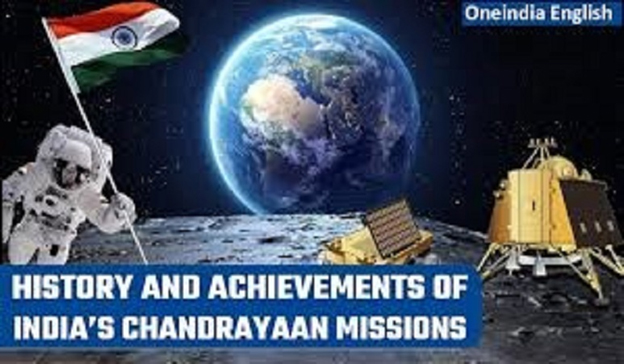
Chandrayaan 2
Chandrayaan-2 lifted off from Sriharikota at 2.43 p.m. on 22 July, 2019 on a Geosynchronous Satellite Launch Vehicle called GSLV-Mk II. In 17 minutes it injected into a geostationary orbit. The ₹978-crore mission is by far the biggest and most complex space mission for India.
The Spacecraft
The Chandrayaan-2 spacecraft comprised a composite module consisting of an Orbiter, a Lander (Vikram), and a Rover (Pragyan). All three components were located in the heat shield of the GSLV MK III rocket – India’s most powerful launch vehicle which is entirely designed and made within the country. And at 3,853 kg, Chandrayaan-2 is the heaviest payload launched by an Indian rocket.
The Objectives
Chadrayaan-2’s voyage to the Moon was nearly 3.8 lakh km, lasting for 54 days. After approaching the 100 km lunar orbit, the Lander covering the Rover was to depart from the Orbiter.
Some of the objectives of the mission were:
- The primary objective of Chandrayaan-2 was to demonstrate the ability to soft-land on the lunar surface and operate a robotic rover on the surface.
- The instruments on the rover to navigate across the site and perform a chemical investigation which included collecting various rock and soil samples to trace the origin and evolution of Moon.
- The orbiter to map the lunar surface and help prepare its 3D maps. The on-board radar was to map the surface to find the possibility of craters that might contain fossilised records of the early solar system in this region.
The Mission Mapping
Chandrayaan 2 was in the Earth’s orbit for 23 days. On the 23rd day, scientists performed the ‘trans-lunar’ injection and Chandrayaan 2 was expected to make a soft-landing on the moon at 2.58 a.m. on
7th September, 2019. It would also take India to where no country has stepped before – the South Pole of the Moon.
The Challenge
A soft landing on the Moon’s surface which is covered with craters, dust and rocks was the trickiest part for the mission. During the touchdown, the lander has to protect the delicate electronic components on board. After landing, the rover was to be slowly positioned over the course of four hours to explore and carry out experiments on the lunar surface for 14 earth days (1 lunar day) while the orbiter will continue its mission for a year.
ISRO had lost contact with lander Vikram on September 7, 2019 as it was 2.1 km above the lunar surface, trying to soft-land on the unexplored South Pole of the Moon. It had a hard-landing very close to the planned touch-down site and while the lander is in a single piece, it is in a tilted position. The module was carrying rover Pragyan and three scientific instruments, meant to study the soil composition, atmosphere, seismic activity and other aspects of the environment around the landing site.
Meanwhile its orbiter in lunar orbit with its eight payloads was to conduct remote-sensing observations for one year from a 100 km orbit above the Moon’s surface. It was the orbiter that had spotted Vikram on the lunar surface on September 8, 2019, making ISRO continue its efforts of re-establishing communication.
Mission Highlights
- Chandrayaan-2 was a three satellite missions stacked in a single launch. Out of the three, two systems – Vikram (lander) and Pragyan (rover) were completely new to ISRO.
- The mission was led by Vanitha Muthayan as program director and Ritu Karidhal as mission director. This is the first time women have headed an interplanetary mission.
- Till date 90 to 95% of the mission objectives have been accomplished and will continue to contribute to lunar science, notwithstanding the loss of communication with the Lander.
Do you know?
The lander of Chandrayaan – 2 is named ‘Vikram’ in honour of Dr. Vikram Sarabhai – the father of the Indian Space program. The rocket GSLV Mk III is also nicknamed “Bahubali”.
-Dr Siddhivinayak Barve
Editor, ScienceNow Digital
