
Black Hole Imaging : Opening a New Frontier in Space Science
While NASA considered building a large space telescope to image black holes for a year, a coordinated effort of the eight radio telescopes from across the globe has helped achieve the milestone decades ahead of time…
In April 2019, the entire world was awestruck looking at the stunning images of a supermassive black hole at the center of Messier 87 (M87) – an elliptical galaxy some 53 million light-years from Earth. A team of international astronomers had achieved the impossible by imaging a black hole 6.5 billion times the mass of the Sun; considering the fact that scientists were expecting completely black images as they believed no light ever escapes it. The greatest challenge of the project was to capture hot glowing gas falling into the black hole from thousand or even millions of light-years away. Working for well over a decade, the scientists of EHT – an international network of radio telescopes called the ‘Event Horizon Telescope’ finally achieved this historic feat.
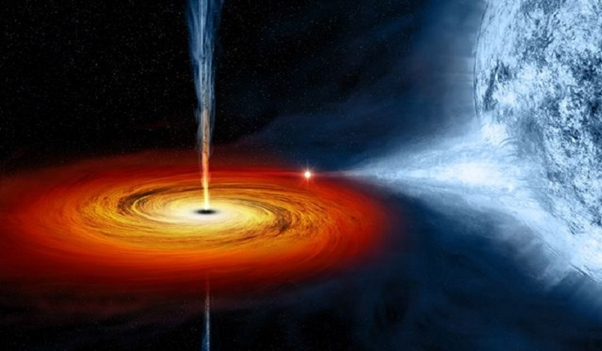
The Challenge: Building an Earth-sized telescope
We are all familiar with the fact that distant space objects are seen using a telescope. The ability of the telescope to see further into the space is determined by its diameter or aperture. The greater its diameter, more light it will gather and higher will be the resolution of its images.
Now, in order to see the black hole situated approximately 53 million light-years from Earth, the scientists were faced with a unique challenge of gathering as much light coming from it onto Earth, in very high resolution. It had to create a telescope on land with a very large aperture, preferably with a diameter as big as the planet Earth.
How they did it?
The scientists decided to resort to a popular technique called Very Long Baseline Interferometry (VLBI), which had been often used for imaging of far-away objects. The crux of this technique was setting up an array of smaller telescopes across locations that are synchronised to focus on the same object at the same time, acting as one giant virtual telescope.
The aperture of a large telescope is as large as the distance between the two farthest-apart telescope stations. In this case with stations at the South Pole and in Spain, the scientist had achieved to create an aperture of the size of Earth. So in a coordinated effort, the EHT operated from across its eight radio telescopes using different wavelengths of light in such a manner that the images it managed to capture seem to look as though taken from one huge telescope of the size of planet earth.
Where to look for?
‘Sagittarius A’, a supermassive black hole was the closest to the Earth at the centre of our Milky Way galaxy at a distance of 26,000 light-years. Definitely, it was not the only black hole in our galaxy, but being closest it would appear largest of all. Being the closest to Earth and in the same Milky Way, Sagittarius A may seem a natural choice, but it had several technical challenges.
Located in the same galaxy meant that while imaging the black hole, one had to be conscious of ‘pollution’ caused by stars and space dust, meaning that scientists would have more data and that they would have to filter it while processing it.
Why Messier 87 (M87)?
Located at the center of the gigantic elliptical galaxy Messier 87 or M87, is one of the largest known supermassive black hole, 53 million light-years away. It is more massive that ‘Sagittarius A’ containing 6.5 billion solar masses (i.e. one solar mass is equivalent to mass of our Sun). Importantly, it was an active black hole with matter falling into it and spewing out in the form of jets of particles. While its distance made its imaging a challenge as compared to ‘Sagittarius A’, processing the data of the image was comparatively easier.
Mission Accomplished
Thirteen partner institutions worked together to achieve this exceptional breakthrough, which a generation ago was presumed to be ‘impossible’, undoubtedly a rare example of ‘global teamwork’. Once again, in a joint pursuit to ‘know more about the unknown’, scientists from across the globe have managed to harness their unique technological expertise to write this innovative algorithm of ‘mankind’s triumph over matter’.
-Manoj Mahanta
Team ScienceNow
