

-Team ScienceNow
Let’s Check your IQ….
1. Which of the following is a large blood vessel that carries blood away from the heart?
A. Vein
B. Artery
C. Capillary
D. Nerve
2. Which of the following is not a member of the Vitamin B complex?
A. Thiamine
B. Riboflavin
C. Folic acid
D. Ascorbic acid
3. Fungi are plants that lack:
A. Oxygen
B. Carbon dioxide
C. Chlorophyll
D. None of these
4. What makes a reptile a reptile?
A. Cold blooded
B. Warm Blooded
C. Non-Hearing
D. Egg-laying
5. Which blood vessels have the smallest diameter?
A. Capillaries
B. Arterioles
C. Venules
D. Lymphatic
6. Tell the composition of soap?
A. Sodium salt with fatty acids.
B. Potassium salt with fatty acids
C. Both a & b
D. Sodium and Potassium salt mixed with chemicals
7. Which of the following compound is not used as an alkali?
A. Sodium hydroxide
B. Potassium hydroxide
C. Carbon hydroxide
D. Nitrogen hydroxide
8. Which acid is present in lemon?
A. marlic acid
B. citric acid
C. lactic acid
D. tartaric acid
9. Natural rubber is a ________ which is having high elasticity.
A. Substance
B. Material
C. Elastomer
D. Chemical using carbon as main compound
10. Which of the following is not a type of elements?
A. Metals
B. Non Metals
C. Metalloids
D. Gases
11. What is the full form of ASLV?
(A) Augmented Satellite Launch Vehicle
(B) Automatic Satellite Launch Vehicle
(C) Aero Space Launch Vehicle
(D) Area Satellite Launch Vehicle
12. Which is India's first experimental satellite launch vehicle?
(A) ASLV
(B) GSLV
(C) SLV 3
(D) None of these
13. When was the Indian Space Research Organisation (ISRO) was set up?
(A) 1962
(B) 1969
(C) 1972
(D) 1952
14. Where is the Headquarter of ISRO?
(A) Chandipur
(B) Bengaluru
(C) Mahendragiri
(D) Chennai
15. The weight of an Object on planet Mars is 348 N. Then what will be the mass of the object?
(A) 100 Kg
(B) 100 Gm
(C) 3.48 Kg
(D) 348 Kg
16. A boy standing at a distance of 172.5 meter from the base of tower shouted 'Hello'. After
what time can the boy hear the echo if the speed of sound is 345 meter per second?
(A) 0.5 sec.
(B) 1 sec.
(C) 1.5 sec.
(D) 2 sec.
17. On what principle is the construction of submarine based on?
(A) Law of gravitation
(B) Law of Inertia
(C) Pascals law
(D) Archimedesprinciple
18. A car travels 500 m distance in 3 minutes. What will be its speed in kilometre per hour?
(A) 120
(B) 100
(C) 15
(D) 30
19. Find the power of an engine working at the rate of 60 Joule/min?
(A) 60 watts
(B) 10 watts
(C) 0.1 watt
(D) 1 watt
20. When an object is kept between two plane mirrors making a certain angle, 5 images are
formed. What is the measure of an angle between the plane mirrors?
(A) 60 degree
(B) 90 degree
(C) 120 degree
(D) 72 degree
21. In which pair, units of given physical quantities are different?
(A) speed, velocity
(B) energy, work
(C) density, volume
(D) weight, force
22. The fluorescent tubes and neon sign bulbs glow because of ___________
(A) High density of gases
(B) High temperature of gases
(C) High applied voltage
(D) Presence of charged particles
23. The ratio of the masses of moving objects X and Y having equal momentum is 1:2.
Determine the ratio of their velocities.
(A) 2:1
(B) 1:2
(C) 4:1
(D) 1:4
24. Which of the following does not have methane as a major component?
(A) LPG
(B) LNG
(C) CNG
(D) Biogas
25. The batteries in the satellite are recharged by _____________
(A) Changing chemicals in the batteries
(B) Changing electrodes in the batteries
(C) Solar panels when there is sunlight
(D) Photo electric cell at any time when necessary
-Team ScienceNow
ANS
1.b, 2.d, 3.c, 4.d, 5.a, 6.c, 7.d, 8.b, 9.c, 10.d, 11.a, 12.c,
13.b, 14.b, 15.a, 16.b, 17.d, 18.b, 19.d, 20.a, 21.c, 22.d, 23.a, 24.a, 25.d
Riddle – Science Teaser
SOLVE THIS
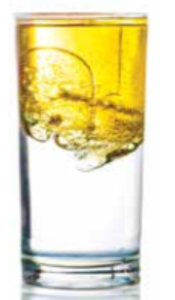
Clumsy Vijay got himself into a ticklish situation. He had poured water into two bottles. One of them had ethanol in it while the other had some oil. Now he wanted to take the water out of them. Can you help him do that?…
SOLUTION
The solution to Vijay’s problem is rather simple. Oil and water do not mix. So it would be easy to separate them. All that he would have to do is to pour the liquid from that particular bottle into a separation funnel. If he now gives it some time the two immiscible liquids would separate with a clear demarcation line. He should now resort to the process of decantation. If he merely pours out oil in the top layer, the remaining liquid will be water. If he uses the separation funnel he can open the tap at the bottom and let water come out. On the other hand, ethanol which is an alcohol mixes with water so mere decantation will not help. He should employ the technique of fractional distillation. Fortunately for Vijay alcohol boils at a much lower temperature than water. So he can let alcohol evaporate at that temperature and then collect the remaining water
-Team ScienceNow
This Month.. That Year….
December 1571:
German astronomer Johann Kepler discovered elliptical orbits.
December 1621:
Galileo perfected his invention of the telescope.
December 1743:
German chemist Martin H. Klaproth discovered uranium.
December 1773:
George Cayley founded the science of aerodynamics and invented gliders.
December 1792:
English inventor Charles Babbage invented the calculating machine.
December 1813:
Irish chemist and physicist Thomas Andrews discovered the ozone.
December 1818:
Physicist James Prescott Joule discovered the principle of conservation of energy.
December 1852:
Scientist Antoine Henri Becquerel discovered radioactivity and won the Nobel Prize in 1903.
December 1856:
English physicist Joseph John Thomson discovered the electron and won the Nobel Prize in 1906.
December 1879:
Thomas Edison patented a magnetoelectric machine.
December 1906:
Peter Carl Goldmark developed colour TV and LP records.
December 1924:
John Backus invented FORTRAN, a computer language.
December 1952:
Larry Bartlett invented a photographic printer
-Team ScienceNow
This star chart is for early December 9 pm mid December 8 pm and end December 7 pm .
To use this chart, hold the star chart vertically ,face any direction in the sky. Turn the star chart around so that the direction you are facing is at the bottom.

Now, the stars shown at the bottom in the chart are the stars you will see in the sky .
Dots represent stars. The larger the dot the brighter the star.
Lines between stars are imaginary and aid location .
Names of constellation are along each side each constellation
|
Monthly phases |
|
|
Full moon |
08 December 2022 09:38 |
|
Last quarter |
16 December 2022 14:26 |
|
New moon |
23 December 2022 15:47 |
|
First quarter |
30 December 2022 06:51 |
|
Full moon |
07 January 2023 04:38 |
–Suhas Naik-Satam
Nehru Planetarium
Recently the outbreak of Measles is Causing alarming concern in Maharashtra as well as in the other parts of the Country… In past months the infection is spreading among the children and quite a number of casualties have been reported..
The latest figure states that there are over 10000 active cases in the state.
Measles is the respiratory disease which remains a leading cause of death among young children, despite the fact that a safe and effective Vaccine has been available for 40 years. Measles is an acute illness caused by a virus of the Paramyxovirus family.
The Maharashtra government has kicked off a vaccination drive to protect children against Measles, Rubella and it plans to vaccinate young children in coming weeks.
The vaccine will be provided free of cost in public run hospitals.
Measles is a contagious disease and proper care has to be taken. Proper vaccination is the only right way to control the disease.
-Team ScienceNow
Thank you very much for your overwhelming response to the maiden post of ‘ScienceNow Digital’…
The Inaugural Issue of ‘Science Now Digital’ was soft launched ahead of the festive season and in celebration of 75 years of India’s Independence. ScienceNow Digital is applauded by virtually everyone who has come across the Digital Version of Science Magazine for the pragmatic venture of taking Science to the Masses. The effort is commended for the Audio Mode attached as an augment to this novel venture.
ScienceNow Digital will strive hard to bring Science Communities together spanning from School to Scientist. It is a humble effort to bring the latest in Science for the masses. Over the months, new features will be added, like latest in Science News, Fiction, Interviews and many more novel features to make a complete Science Magazine digital available Anytime.. Anywhere…
This post brings out the lead story on latest advent of 5G Technology. The revolutionary 5G technique will transform the Social and Business environment. The high speed connectivity will bring about the desired change in Education, Health and Business, touching almost every domain of human endeavour. It will be a boon for ScienceNow Digital as well… as it will be delivered more powerfully.
Every effort is made to make the issue interesting by adding Quiz, Science Trivia, at the same time not forgetting the achievements of ancient science. Your suggestions are most welcome to improve ScienceNow Digital for marching together towards Science Excellence.
That is the promise…
Scientifically yours,
Dr Siddhivinayak Barve
Editor,
ScienceNow Digital
The new Kookaburra Smart Ball is all set to revolutionize the world of cricket. Read on….
For the first time, the ball will talk! Yes, you have read it right. Kookaburra, leading cricket ball manufacturer from Australia, has teamed up with SportCor to develop world’s first Smart Ball that will have microchip inside. The chip will provide real–time data that will change the way we coach, play and experience the game.
Statistical Data
The role of Kookaburra Smart Ball would be to collect and relay all the statistical data instantly pertaining to revolutions, speed at which the ball is released, bounce, etc. through the embedded microchip located inside. In turn this will provide an immense insight for coaches, umpires, bowlers and an up and close experience for viewers like never before. For instance: once a bowler bowls the delivery he can immediately check his/ her smart watch and check the speed or degree of turn. The information can also be relayed on one’s smartphone or tablet app for coaches and trainers to take further course of action.
The Smart Ball will also have future capabilities of performing tasks like reading pitch behaviour, whether the ball has nicked the bat, whether the ball has hit the grass during low ground catches, and even assist in DRS process.

Science in Smart Ball
The microchip will be fitted in the smart ball’s core. Later layers of leather and rubber will be wrapped over it, then like other normal cricket balls different pieces of the balls will be gathered and stitched. This smart ball would look, feel and move like a normal cricket ball.
Challenges
At present, manufacturers are still working on the ball and it would take at least a year before it is allowed in any first class game. The primary concern would be the longevity issue that is how long the ball would last. But manufacturers are confident that the battery will last for about 8 hours which is a day of Test cricket. However, the battery can be recharged at any point of time by placing the ball in its charging hold. As far as chips is concerned it will last for about 18 months (outliving the normal life of a cricket ball), but manufacturers are working on increasing the timeframe. Once accepted, the smart ball will add to the long list of technology which is already in use in today’s cricketing world.
Manoj Mahanta
ScienceNow Digital
Breath-taking Speed… Even before you think it is done…. Now 5G is here… to change the world for better. Launched in India by Prime Minister Narendra Modi on 1st October at India Mobile Congress in New Delhi…It is a game-changer Technology…Connecting People and bringing the world closer…
learn what 5G is and how it will deliver…
This is 5 G.. yes, it represents the fifth generation of mobile network technology… 5G is an innovation platform… It will entirely change what we can do with mobile connectivity…5G is so much more than just another ‘G’, which will only be limited by imagination. Now India is 5G Ready and the 5G network will unfold in the country in coming months… So Get ready to for a revolutionary change in the business and society…
How 5G Different…

Till today we are using mobile networks for voice and messaging, web-browsing and data and video streaming. The new transition with 5G will benefit both consumers and businesses. 5G will see billions of connected devices gather and share information in real-time, transforming the world, creating more opportunities for everyone.
Almost everything will experience transformation, with the capability of sharing large volumes of data in literally in split second time, with lag free network making the data processing and storage more efficient. The new 5G network will be 100 times faster…
Imagine India with limitless connectivity which will definitely open up limitless possibilities. Connectivity will enable an exciting future, and a stronger Digital India.
Network
Existing 2G, 3G and 4G networks primarily use radio focused technologies, 5G deploys combo with radio, a telecom core, and an operation system. This process will involve cloud-based core, incorporating new concept technologies like network slicing. 5G networks uses low, mid and high radio frequencies. 5G networking technologies will provide wireless connectivity to the devices.
All in One Technology..
5G will open up huge opportunities with tremendous Societal Benefits, especially for our country. It will help Education, Health and Industrial Transformation. The capabilities of the technology are real and 5G is here and ready to be deployed.
Benefits
5G is by far the most energy efficient of all the generations of mobile technologies. The emerging 5G and IoT will revolutionise the world and even will lead to reduction in global emissions and help in combatting climate change, which will ultimately support a sustainable future for everyone
Limitless Possibilities
When technology connects, extraordinary things become a reality. The 5G Technology will help reaching and educating remotely placed students across India. Digital labs will help learners to gain the skills, leveraging ICT to enhance learning outcomes.
Limitless connectivity will help transform India’s industries for the better. 5G Technology enabled smart businesses can gain massive benefits in terms of sustainability, productivity as well as efficiency. Smart enterprises powered by the next generation network will be a key economic multiplier realizing the true ‘Digital India’.
The 5G connectivity can usher a new era of remote healthcare platform, enabling healthcare professionals to carry out remote diagnostics on patients from remote rural location. 5G technology will also enable access to healthcare in remotest parts of the country.
5G Technology will a game-changer in unleashing new dimensions in sports and entertainment sectors, which will enable a new era, which will be more interactive, available anytime, anywhere.
The 5 G Technology will in real sense open the Digital Economy to all, leading to commercial and social benefits. The 5G Technology will provide easy access to financial services.
Thus the future is here… 5G will be socio-economic multiplier for the country, realising the dream of Digital India.
Dr Siddhi Barve
ScienceNow Digital
