science share account_circle

Author: sn_admin

  • Know the fascinating Facts

    Do you Know??

    Know the fascinating Facts….

    Why is DIAMOND the hardest substance on Earth

    Diamonds are incredibly hard because they have crystallized in a particular atomic shape after being subject to the effect of heat and pressure on Earth at a depth of 140 to 150 kilometres. This makes diamond the hardest mineral on earth and cannot be broken or cut easily. It is only possible by using another diamond.

    Why do FORMULA 1 driver lose weight

    The F1 drivers can lose up to three kgs weight after a race due to extreme heat in the cockpit of the vehicle. Hence, the drivers take in large amounts of water before the race, even if they do not feel thirsty, to avoid dehydration through sweating

    Why do we get HEATSTROKE

    Heatstroke is a condition caused by your body overheating, usually as a result of prolonged exposure to or physical exertion in high temperatures. This most serious form of heat injury – heatstroke, can occur if your body temperature rises to 104 F (40 C) or higher.

    Why do NEWSPAPERS turn yellow over time

    Paper is made from wood, which is made up mainly of white cellulose. Wood also has a lot of a dark substance in it called lignin, which ends up in the paper, too, along with the cellulose. The exposure of lignin to air and sunlight is what turns paper yellow.

    Why is SUN harsh in summer

    In the early morning and late evening, UV (ultraviolet) radiation is less strong because the rays have farther to travel to get to the Earth. But throughout the year, the sun’s angle varies with the seasons, so the strength of UV rays change, too. UV rays are strongest in the summer months.

    -Team ScienceNow

  • Film Review

    Film Review

    Ghostbusters

    That’s right, folks, another Ghostbusters film! Only this time we are going back to the original 1980’s gang of Murray, Aykroyd, Hudson, and Weaver returning to their original roles. Joining the crew will be Paul Rudd and Stranger Things star Finn Wolfhard….

    The third Ghostbusters film has been in various stages of development since Ghostbuster II in 1989 and is now fi nally seeing the light of day (to be released on July 10, 2020). Taking place thirty years after the events of the second movie, the plot follows a single mother and her two children who move to Summerville, Oklahoma after being evicted from their home and inherit property from their late grandfather, Egon Spengler. When the town experiences unexplained earthquakes; the children discover their link to the original Ghostbusters who have become something of a long-forgotten myth.

    -Team ScienceNow

  • Know Geology

    Know Geology…

    Earth’s Interior

    Our mother Earth is formed around 2.5 billion years ago.

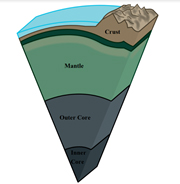
    The Earth was a hot ball of molten rocks at the time of her formation. She gradually cooled down from the surface inside, and currently is comprised of three distinct layers; the crust, mantle, and core. Let us understand each of the layer in detail.

    Crust: The Earth’s crust is the outermost layer of the Earth. Generally, the crust comprises of only first 100 km of the Earth’s interior. That is not even 2% of the total thickness of the Earth’s interior. But all the mining operations take place in this layer itself. This is becausewe do not yet possess the technology to drill deeper than even 15 km into the Earth’s interior (the deepest human interaction as of today is the Kola Superdeep Borehole, Russia (~12.3 km)). This crust can be divided into two types; continental crust and oceanic crust. As the name suggests, the continental crust carries the continents, while the oceanic crust hosts oceans. The continental crust can be further divided in three layers. The first layer is 2 km thick, and is the lightest among them, with rock density approximately 2,200 kg/m 3 . This layer mainly comprises of sedimentary rocks. Important outtake from this layer is the soil we use for agriculture. The second layer goes up to 30 km depth, and comprises mainly of silica and alumina. Thus, this layer is also called as SIAL. Third layer reaches to boundary between the crust and the mantle, and mainly consists of silica and magnesia, earning it the name SIMA. Density of the rocks in this layer increases up to 2,800-3,000 kg/m 3 . This layer mainly comprises of igneous rocks.

    Mantle: The second layer, the mantle, starts under the crust, and extends up to 2,900 km depth. The boundary between crust and mantle is called ‘Mohorivicic Discontinuity’. The mantle can be divided into two regions; upper mantle and lower mantle. The boundary between the upper and lower mantle is located approximately at 700-800 km depth. The upper mantle can even further be divided into two layers, the first being the crazy one. This layer is called ‘Asthenosphere’. Asthenosphere means a layer of week particles. The asthenosphere is in the plastic state, instead of solid state. It means that the asthenosphere changes its shape according to the forces from the crust and mantle around it. Despite of the plastic state, the asthenosphere is able to bear the load of the crust. The reason behind this is the difference in densities. In the mantle, the density of rocks increases from 3,300 kg/m 3 in the beginning to 5,700 kg/m 3 in the end. Therefore, the lighter crust floats on the denser asthenosphere. The lower mantle is in the liquid state due to extreme heat. Mantle is also the region, where the subducted continental places arrive. Due to the heat and pressure, the plates melt, and are added to the Earth’s magma supply. This magma again reaches the Earth’s surface through volcanic eruptions and forms igneous rocks. Therefore, the mantle works as a furnace, where the utilized crust materials are recycled.

    Core: The Earth’s core begins at the end of the mantle, and extends up to the center of the Earth. Boundary between the mantle and the core is called ‘Gutenberg Discontinuity’. The core can be identified by the steep increase in the rock densities. The density of rocks, which was 5,700 kg/m 3 at the conclusion of the mantle, suddenly increases to 9,900 kg/m 3 . The density keeps increasing as we go even deeper, and it maxes out at 13,000 kg/m 3 at the center of the Earth. The core is made of iron and nickel, and the movement of iron and nickel particles in the core results in the formation of convection currents. These convection currents ultimately form the Earth’s magnetic field, or magnetosphere. The core can be divided into two regions; outer core and inner core. The outer core starts its regime from 2,900 km depth, and extends up to 5,150 km depth. Inner core covers the rest of the thickness of the Earth’s interior. Inner core is in reality the hottest, but still in solid state, due to compressive pressure from surrounding crust, mantle and outer core. The difference in the rock densities throughout the Earth’s interior can be found by sudden change in the properties of seismic waves.

    -Ninad Bhagwat,

    Montana Tech University, USA


  • Ocean Currents Stops

    What if? ?

    Ocean Currents Stops

    Ocean currents play a significant role in controlling climate around the globe. These currents act like a giant conveyor belt, warming and cooling parts of the Earth as water circulates. Melting ice caps, which can happen due to global warming, can cause ocean waters to circulate and have a drastic effect on climate…

    What are Ocean Currents ?

    Around the world, there are a number of ocean currents which have a serious impact on climate. For instance: The Gulf Stream in the Atlantic transports warm water with a high level of salinity and low density from equatorial regions further north on the ocean’s surface, warming countries such as the United Kingdom.

    The further north the water travels, the cooler it gets. Cold water becomes denser, falls further towards the bottom of the ocean and is carried back further south. This causes a continual ocean current in the North Atlantic.

    Global Warming

    Polar ice caps are beginning to melt due to global warming. Since ice caps are composed of freshwater, and if they continue to melt, it would bring down the level of salinity in the surrounding ocean waters. Changes in salinity levels could affect thermohaline currents by preventing water from achieving enough density to sink to the bottom of the ocean. More seriously, ocean currents could stop completely.

    Effects of Ocean Currents

    If ocean currents were to stop, climate could change drastically, especially in Europe and countries in the North Atlantic. In these countries, temperatures would drop, affecting humans as well as plants and animals. In turn, economies could also be affected, particularly those that involve agriculture. If these effects were to continue, Europe, North Atlantic countries and parts of North America could experience long periods of freezing conditions. Also, if ocean currents stopped because of climate change it will have many other affects associated with the globalwarming phenomenon.

    Earlier Phenomena

    Earlier evidence of rocks and ice have shown that ocean currents have indeed stopped for periods of time in history. One example can be found around 13,000 years ago when the warmth experienced at end of an ice age caused large masses of ice to melt into the sea.

    The resulting changes in water density stopped ocean currents from flowing and caused freezing conditions in some parts of the world for over 1,000 years.

    -Team ScienceNow

  • Sky Watch

    Star Chart – March23

    This Star Chart is for early March 9 pm, Mid March 8 pm and end  March 7 pm.

    To use this chart, hold the star chart vertically, face any direction in the sky. Turn the star chart around so that the direction you are facing is at the bottom.

    Now, the stars shown at the bottom in the chart are the stars you will see in the sky.

    Dots represent stars. The larger the dot the brighter the star.

    Lines between stars are imaginary and aid location.

    Names of constellation are along each side 

    Phases of Moon

    Full moon

    25 March 2024

    Last quarter

    03 March 2024

    New moon

    10 March 2024

    First quarter

    18 March 202408


    Mr Suhas Naik-Satam

    Nehru Planetarium


  • Science Calendar

    Science Calendar

    March

    Get acquainted with Important Science Day Celebrations in March

    3rd March

    – World Wildlife Day
    This day is celebrated globally on 3rd March and is closely aligned with Sustainable Development Goal 12 that is Life without water, which focuses on marine species and highlights the problems, critical issues of marine wildlife to our everyday life. The theme of World Wildlife Day 2023 is “Recovering key species for ecosystem restoration”.

    4th March

    – National Safety Day
    National Safety Day is celebrated in India on 4th March by the National Safety Council of India. This day is celebrated to make people get safe from several issues like financial loss, health problems, and also any other problems that people are facing in their life.

    8 March

    – International Women’s Day
    This day is observed globally every year on 8 March to celebrate the social, economic, cultural, and political achievements of women. Also, it is an action for accelerating gender parity. Purple is the colour that symbolizes women internationally. The combination of the purple, green and white colour is to symbolize the equality of women which is originated from the Women’s Social and Political Union in the UK in 1908. Do you know that purple signifies justice and dignity, green symbolises hope and white purity?

    9 March

    – No Smoking Day 

    No Smoking Day is observed every year on the second Wednesday of March to raise awareness about the harmful health effects of tobacco via smoking and to encourage people all over the world to quit smoking. This year, it falls on 9 March.

    10 March

    – CISF Raising Day
    The Central Industrial Security Force (CISF) Raising Day is observed every year on 10 March. The CISF was set up in 1969 under the act of the Parliament of India. It works under the Union Ministry of Home Affairs and its headquarter is in New Delhi. This organization works for seaways, airways, and some of the major installations in India. There are some reserved battalions in the CISF which work with the state police to protect law and orders.

    14 March

    – Pi Day
    On 14 March Pi Day is celebrated around the world. Pi is a symbol used in mathematics to represent a constant. It is the ratio of the circumference of a circle to its diameter which is approx. 3.14.

    15 March

    – World Consumer Rights Day
    It is observed on 15 March every year for raising global awareness about consumer rights and needs. This day is a chance to demand that the rights of all consumers are respected and protected and to protest against social injustices.

    16 March

    – National Vaccination Day
    On 16 March every year, National Vaccination Day is observed in India which is also known as National Immunisation Day (IMD). It was first observed on 16 March 1995 when the first dose of Oral Polio Vaccine was given. It is an attempt to increase awareness for the eradication of polio from the planet earth.

    18 March

    – World Sleep Day

    World Sleep Day is held the Friday before Spring Vernal Equinox of each year. This year, it will be observed on 18 March 2023. It is a call to action on important issues related to sleep, including medicine, education, social aspects, and driving. The slogan of World Sleep Day is Better Sleep, Better Life, Better Planet. .

    20 March

    – World Sparrow Day
    World Sparrow Day is celebrated across the world on 20 March to raise awareness about the conservation of sparrows. This day also celebrates the relationship between people and sparrows; spread a love for sparrows, awareness about their importance in our lives, etc.

    21 March

    – World Forestry Day
    On 21st March, World Forestry Day or International Day of Forests is celebrated every year to raise public awareness about the values, significance, and contributions of the forests to balance the life cycle on the earth. In 1971, World Forestry Day was established at the 23rd General Assembly of the European Confederation of Agriculture.

    22 March

     – World Water Day
    On 22 March, World Water Day is observed annually to raise awareness about the importance of freshwater and advocate for the sustainable management of freshwater resources. It was recommended to celebrate in 1992 at the United Nations Conference on Environment and Development (UNCED) in Rio de Janerio. And then, in 1993 the first World Water Day is celebrated.

    23rd March

    – World Meteorological Day
    World Meteorological Day is celebrated on 23rd March every year to attract attention towards weather and climate for the safety and well-being of the society. On 23rd March 1950, the World Meteorological Organisation came into force. The theme of World Meteorological Day 2023 is “Early Warning and Early Action. Hydrometeorological and Climate Information for Disaster Risk Reduction.”

    24 March

     – World Tuberculosis (TB) Day
    World TB Day is celebrated every year on 24 March annually to commemorate the date when Dr. Robert Koch announced his discovery of Mycobacterium tuberculosis, the bacillus that causes TB in 1882. This Day is observed to educate people about TB, its impact around the world.

    26 March

     – Purple Day of Epilepsy

    It is observed on 26 March to spread awareness about epilepsy and its impact on people’s lives. The day also reminds people suffering from epilepsy that they are not alone.

    -Team ScienceNow

  • Innovation Conclave and Innovation Awards

    Innovation Conclave and Innovation Awards

    Kelkar Education Trust’s V G Vaze College (Autonomous), Mulund (e), Mumbai and Scientific Research Centre, Mulund (e), Mumbai organized an Innovation Conclave celebrating Excellence in Innovations.

    The Progreamme was held on 26th Jan 2024, the Republic Day on which India is entering 75th year of establishment of Indian Republic. On this auspicious occasion the Innovation Conclave is organised to celebrate Excellence in Innovation by holding a Plenary Session on Innovations in India. Noted Scientists, Industry and Media experts participated in the Plenary Session deliberating on Innovation, Incubation, VCs and Start-ups and in the conclave Innovation Excellence Awards were given to Innovators in the fields of Science and Technology.

    The Programme was jointly organised by V G Vaze College and Scientific Research Centre, when the college is entering its 40th Year of its establishment and the Scientific Research Centre is a post Silver-Jubilee Premier Research organization in the country.

    The Programme was organised by Divya Media, Thane

  • Greetings!

    Greetings!

    In this Science Month Greetings on the occasion of the National Science Day! We Celebrate the Science Day in honour of the Nobel Discovery by great Scientist Sir C V Raman.

    As the culture of Innovation is setting in India, the world is looking to India for the Research and Development at Global Level…Aptly so, the theme of this year’s Science Day Celebrations is ‘Indigenous Technology for Vikasit Bharat’… This is the time that India has an opportunity to showcase its talent at global level…

    In line with Innovation, some noteworthy developments are in the offing… To encourage and foster the innovation amongst the youth on the auspicious occasion of India entering 75th year of formation of Indian Republic, V G Vaze College, Mulund in collaboration with Scientific Research Centre organised Innovation Conclave. The event featured the discussion on Innovation in India and in the function the best Innovative projects were rewarded with Prizes and guidance for Patenting and Funding…

    This is indeed in tune with the spirit of National Science Day theme of putting Indian Science at the Global level, encouraging innovators and entrepreneurs to showcase their talent at the world level.

    As ScienceNow Digital marches ahead, it is our commitment, with your support to bring out the best in Science…and that is the promise!

    Scientifically Yours

    Dr Siddhivinayak Barve 


  • National Science Day

    National Science Day

    National Science Day is Celebrated on 28th Feb every year. The day marks the announcement of the Discovery of Raman Effect by Sir C V Raman…

    In India National Science Day (NSD) is celebrated on February 28 every year. This day marks the

    discovery of the Raman effect phenomenon of the Scattering of light by the Indian Physicist Sir C.V

    Raman on 28 February, 1928. For the discovery of the Raman effect, he was awarded the Nobel Prize in 1930.

    Keeping this in mind, the National Council for Science and Technology Communication (NCSTC)

    decided that every year 28 February will be celebrated as National Science Day. The request was

    approved by the Government of India, and from 1936 onwards, this day is celebrated by the whole of India as the National Science Day.

    Theme of National Science Day

    Every year National Science Day is celebrated with a theme that spreads the message about the

    importance of science. This year Department of Science and Technology decided the theme of National Science Day 2023 as “Global Science for Global Well being”. The theme is dedicated to science, with the aim to highlight India’s role in Science and Technology globally.

    Objectives of celebrating National Science Day

    The main objective of celebrating National Science Day is to widely spread a message about the

    importance of science in the daily life of people. It is celebrated to discuss all the issues and implement new technologies for development in the field of science. Significantly it gives an opportunity for people in the science fraternity and scientific minded citizens in the country to encourage to come together and work towards promoting science.

    How is National Science Day celebrated?

    The National Science Day is celebrated across the country by organizing different science exhibitions,

    seminars, workshops, public speeches, science movies, exhibitions on the concept of themes, live

    projects, quiz competitions, and many more such activities.

    -Dr Siddhivinayak Barve

    Editor, ScienceNow Digital

  •  ‘HARMONY FOR TOMORROW: A SUSTAINABLE SYMPHONY’

     ‘HARMONY FOR TOMORROW: A SUSTAINABLE SYMPHONY’

    “SOWING SEEDS OF WELL-BEING: NURTURING HEALTH AND MINDS”

    Introduction:

    As we progress through the journey of “Harmony for Tomorrow: A Sustainable Symphony,” our second movement resonates with the theme, “Sowing Seeds of Well-being: Nurturing Health and Minds.” This episode delves into the profound objectives of Sustainable Development Goals (SDGs) 3 and 4- cultivating well-being and fostering inclusive education.

    SDG 3

    Good Health and Well-being

    The third movement in our symphony is dedicated to SDG 3, which calls for ensuring good health and well-being for all. The 2030 deadline underscores the urgency of creating a world where everyone has access to quality healthcare, essential medicines, and disease prevention.

    In India, a success story unfolds in the realm of healthcare, demonstrating remarkable strides in accessibility and disease prevention. The narrative is one of transformation, where concerted efforts have been made to reach even the remotest corners of the nation with essential health services.

    India’s success in healthcare accessibility is multifaceted, involving a blend of policy initiatives, community engagement, and technological interventions. Mobile health units, community health workers, and telemedicine have played pivotal roles in extending healthcare services to underserved populations. These initiatives not only address existing health challenges but also lay the groundwork for proactive disease prevention.

    From the eradication of diseases like Polio to ongoing efforts in combating Malaria and Tuberculosis, India’s journey showcases a commitment to the well-being of its citizens. The success story echoes the symphonic harmony of healthcare accessibility and disease prevention, illustrating that a healthy society is the bedrock of a sustainable future.

    SDG 4

    Quality Education

    The fourth movement in our symphony focuses on SDG 4, emphasizing the significance of quality education. The 2030 deadline challenges nations to ensure inclusive and equitable education for all, breaking down barriers and fostering lifelong learning opportunities.

    In India, a transformative success story emerges from the realm of education, where digital initiatives and inclusive policies have revolutionized the learning landscape. The narrative unfolds in classrooms equipped with digital tools, reaching students in urban centers and remote villages alike.

    Digital initiatives, such as online education platforms, smart classrooms, and e-learning resources, have transcended geographical constraints, democratizing access to quality education. These initiatives not only cater to the diverse learning needs of students but also bridge gaps in educational opportunities.

    Inclusive policies, such as those promoting gender equality in education and providing support for children with special needs, ensure that no one is left behind on the journey to knowledge. The success story in India’s education sector exemplifies the harmonious integration of inclusivity and technological innovation, fostering an environment where every student has the opportunity to thrive.

    A Symphony of Well-being and Inclusive Education

    As we reflect on the success stories from India under SDG 3 and SDG 4, a harmonious integration of well-being and inclusive education unfolds. The interconnected nature of health and education becomes apparent, emphasizing that one is incomplete without the other.

    Good health is not merely the absence of disease; it is a state of complete physical, mental, and social well-being. In the educational context, quality education goes beyond the classroom, nurturing the holistic development of individuals. The symphony we aim to create involves recognizing the synergy between health and education, as both are foundational pillars for a sustainable future.

    The success stories from India under SDG 3 and SDG 4 highlight the potential for holistic solutions that address the interconnected challenges of well-being and education. It is a melody that harmonizes diverse notes- healthcare accessibility, disease prevention, digital initiatives, and inclusive policies- to create a balanced and sustainable future.

    The Urgency of Sowing Seeds of Well-being and Knowledge

    The urgency of sowing seeds of well-being and knowledge is underscored by the realization that time is of the essence. The 2030 deadline for the SDGs demands concerted efforts to ensure the well-being of societies and the empowerment of future generations through education.

    College students, as the torchbearers of the future, must recognize their role in nurturing both individual well-being and the collective wisdom of society. Their ideas, energy, and commitment are instrumental in creating the world we aspire to inhabit.

    As we progress through this sustainable symphony, the success stories from India regarding SDG 3 and SDG 4 serve as beacons of hope, illustrating that a harmonious and sustainable future is within our grasp. In the grand orchestration of “Sowing Seeds of Well-being: Nurturing Health and Minds,” let this symphony resonate in the hearts and minds of college students, inspiring them to be active participants in the creation of a better world for all. Together, we can sow the seeds that will blossom into a legacy of harmony for generations to come.

    Prof Sanjay Deshmukh

    Professor of Life Sciences

    Ex VC Univ of Mumbai