
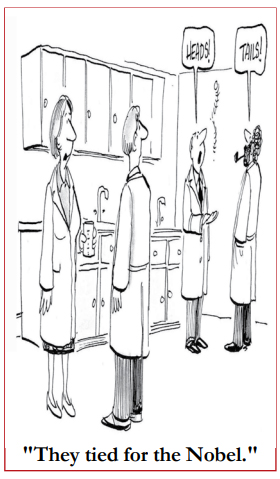
Science Smiles…
In the Lighter Side….
Team ScienceNow
QUIZ
1)Gear up for the food for Brain…
2) If we ever make contact with aliens, which of our fundamental units is likely to match them?
3) If a person beats drum on the Earth and an astronaut beats an identical drum in space, what
will be the differences in the effects?
4) A student fails to complete a presentation. The angry team leader launches him into a rocket
far into space and then throws him out. The student just grazes the upper edge of the
atmosphere during his trajectory. He will…
5) A star is seen rising from Kolkata (23.5-degree N 92-degree E) at 7:00 pm IST, at what time IST
will it be seen to rise from Mumbai (19-degree N 72-degree E)?
6) Which of the following physical quantity is useful to determine the purity of an element?
7) In the polar region in winter the aquatic creatures remain alive under water. For this which
mode of transmission occur?
8) In which range of age human can hear sound up to 25,000 Hz from the following?
9) Which of the following pair is not correct?
10) Which of the following has three chambered heart?
11) Which of the following group is improper to make the magnet?
(A) Iron, Cobalt, Nickel
(B) Titanium, Nickel, Iron, Aluminium
(C) Titanium, Bronze, Nickel
(D) Aluminium, Nickel, Cobalt
12) A lamp of 100 W was used 4 hours daily in February 2016. Then find out how many units of
electricity was consumed in that month
13) Find odd one out according to pH value.
14) The fluorescent tubes and neon sign bulbs glow because of ________
15) Name the gas which turns moist lead acetate solution silvery black.
16) Who am I? I am clean and pollution – free energy. I provide uninterrupted energy to the
space shuttles.
17) Germs in water can be killed by __________
18) Ban on plastic bags is justified because…
19) Which of the following stringed instruments are played by using ring of wire in the finger
(nakhi)?
20) Which natural phenomenon is responsible to produce ozone gas?
21) Leaf of which plant of the following is a reproductive organ?
22) _____________ component of air is formed from coal.
23) From where one can see the sun rising from the west?
24) Select the alternative that has third type of lever
25) What oil is used in toothpaste?
-Team ScienceNow
ANS :
1) B, 2) D, 3) B, 4) A, 5) D, 6) C, 7) C.
8) A, 9) B, 10) D, 11) C, 12) A, 13) C,
14) D, 15) D, 16) A, 17) B, 18) D, 19) D,
20) C, 21) A, 22) C, 23) A, 24) B, 25) D.
Science & Superstitions
Many buildings around the world don’t have the 13th Floor. Instead the elevator may be a label 12B or 14A. So also in some airlines like Air France and Lufthansa, don’t be surprised if the 13th row or 17th row happen to be missing, because people of countries like Italy and Brazil considered them as unlucky….
If someone dear to you sneezes, immediately you respond saying “bless you”. You don’t want the devil lurking around to steal their soul after the sneeze, just as your ancestors believed. Else If you are about to start a new venture or undertake an auspicious activity you wouldn’t want to see a black cat cross your path or see a mirror suddenly break or walk underneath a ladder
In each of the above cases, there appears to be a general belief that some supernatural forces are at work and that they are just about to influence something really undesirable, and one ought to best avoid it before things really go haywire.
While most people prefer calling it their ‘gut feeling’, universally believers of pure logic and science would without mincing any words blatantly call it a ‘superstition’. Decisions that appear to be grossly irrational on the part of the decision maker, and entirely based on one’s belief of an eventual ‘good luck’ and ‘destiny’. And to top it all, one may resort to carrying of charms, wearing certain clothes, visiting places associated with good fortune, preferring specific colours or using of a particular number/sign…
Though most of the listed choices and actions appear to be ‘trivial’ in nature, yet the conviction with which one goes about doing it may surprise one and all. Now at a time when science is making life easy and contributing to much of mankind’s progress and advancement, people have begun questioning one’s blind faith on ‘superstitions’, especially those that have been passed onto us by our ancestors.
While it may not be prudent to junk everything that out-rightly appears to be superstitious, instead one should try to follow the ones which have a scientific and logical basis and not let fear and anxiety push us to accept or do something forcibly. But before calling a spade, a ‘spade’, it is critical that one first develops the requisite scientific outlook and temper to identify a prevailing practice as being a ‘superstition’ and only then do away with it.
While taking a decision, one ought to be conscious of the fact that when ancient Indian scriptures and Aryabhatta put forth the assumption that Earth was round and it revolved around the Sun, the entire western world believed otherwise terming it ‘superstition’.
So also, whenever people in India suffered from communicable or infectious disease, traditionally householders performed some rituals using neem leaves on the affected person, which again was considered to be ‘superstition’ by the elite and learned. However, later when the same people who questioned these practices began discovering the amazing medicinal values of neem plant, they found some sense and logic in these age-old practices. In short, ‘superstitions’ are time tested assumptions – some passed down from generation to generation.
While it is true that unless these so called ‘assumptions’ are empirically found to be correct and eventually explained using some theory or principle, one need not accept them as ‘logical’ or ‘scientific’. But there exist many superstitions which may not have been proved scientifically, yet we cannot call these practices as ‘unscientific’ simply because there is every possibility of mankind not having evolved with as much knowledge to reason its veracity or we may not have the requisite technology to debunk them scientifically.
Though some of the superstitions appear to be quite hilarious, there are a few that are really very interesting and connect to heritage and ethos. In such a scenario, it’s best to do away with those which appear out-rightly ridiculous, but as for those where decision making is very tricky, leave it alone. With the passage of time, as the reasoning behind its origin gradually erodes, the truth will appear all by itself. What is scientific will remain, and what’s superstition will fade out into history. So let’s not try to reason out every superstition, at least for now!
-Dr Shobha Tawde
Team ScienceNow
Know Geology…
Earth’s Magnetic Field
Know Geology in this new series ‘Know Geology’,,,
We live on the planet Earth. The Earth is our provider of all of our needs. As we all know, there are various sources of radiation present on the Earth, such as Uranium, etc. There is also cosmic radiation surrounding us, although the intensity of the radiation is so low that it cannot directly harm us. However, there is a massive amount of radiation in the vast expanse of the universe. Even the Sun emits powerful ultraviolet radiation, which is able to cause fatal cancer like illnesses. Then why is this radiation not able to harm us? The answer lies with the Earth’s magnetic field.
But how has this magnetic field generated? When the Earth was formed around 4.5 billion years ago, she was a hot ball of molten rocks. As the time passed, the Earth’s interior segregated into 3 parts: crust, mantle and core. This core is made of iron and nickel. The core can be divided into outer core and inner core. The outer core is hot, and therefore in liquid state, while the inner core is also hot, but in solid state due to the pressure from surrounding crust, mantle and outer core. Still, the iron particles present in the inner core are constantly moving. When the iron particles on the surface of the inner core get relatively cooler than the particles inside the inner core, they get denser, and move towards the center of the inner core. At the same time, the relatively warmer and lighter iron particles from the interior of the inner core tend to move towards its surface. This movement of the iron particles creates electric currents in the inner core, and the currents are formed inside the inner core. These currents are called as ‘Convection Currents’. The electric currents, combined with the magnetic properties of the iron particles, generate the Earth’s magnetic field, or the magnetosphere.
When the solar winds reach the Earth, they interact with the Earth’s magnetic field, and the interaction causes a glow in the atmosphere. This event is called as ‘aurora’. Generally, due to the bipolar nature of the magnetic field, aurora is only visible in the north and south poles. But when the solar activity is intense, the aurora will move away from the poles, and may be visible even at lower latitudes. An excellent example of this activity was observed on April 22 and 23, 2023, when the solar activity was so intense that the aurora was visible in Ladakh in northern India.
This magnetic field protects the Earth and her inhabitants from harmful cosmic radiation. However, this magnetic field is not completely invincible. In case of strong cosmic activity, the high solar winds can disturb the magnetic field, and geomagnetic storms can penetrate the Earth’s magnetosphere. This can result in the widespread radio and power blackouts. During the greatest solar storm ever recorded, known as the ‘Carrington Event’ in 1859, the solar activity was so intense that the northern aurora moved down to Hawaii and Cuba, while the southern aurora moved up to Santiago, capitol of Chile. This event caused severe disruption of telecommunication around the world, as the telegraph poles were fried and communication was stopped. Similar event took place in 1989, plunging the province of Quebec, Canada into 12 hours of electrical blackout.
Due to this magnetic field, there are charged particles trapped in the atmosphere. The area where the charged particles lie is called as the ‘Van Allen Belt’. The Van Allen Belt is supposed to be uniform around the Earth, but that is not the case. In some places, the Van Allen Belt has come closer to the Earth’s surface. In these areas, conflict between the Van Allen Belt and the Earth’s magnetosphere results in the reduction of the Earth’s magnetic field. In the southern Atlantic Ocean, there is such an area, where the strength of the Earth’s magnetic field is significantly lower than that of the rest of the Earth. This anomaly known as the ‘South Atlantic Anomaly’. Apart from the interaction with Van Allen Belt, there are few other factors, which play a crucial role in the reduction of the magnetic field. These factors include global warming, climate change, use of chlorofluorocarbons, etc. Without the magnetic field, the powerful solar winds would blow away the Earth’s atmosphere, and cause fatal cancer like illnesses on the Earth. The Earth as we know her would not exist, and instead a desolate planet would remain behind, should the Earth’s magnetic field vanish.
-Ninad Bhagwat
Montana Technological University, USA
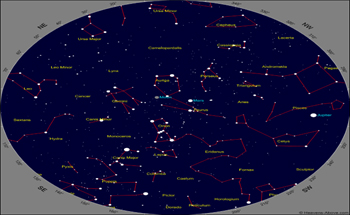
Star Chart
Get a guided tour of the Sky above you…
This star chart is for early February 9 pm, mid February 8 pm and end February 7 pm .
To use this chart, hold the star chart vertically ,face any direction in the sky. Turn the star chart around so that the direction you are facing is at the bottom.
Now, the stars shown at the bottom in the chart are the stars you will see in the sky .Dots represent stars. The larger the dot the brighter the star.
Lines between stars are imaginary and aid location. Names of constellation are along each side
|
Monthly phases |
|
|
Full moon |
24 February 2024 18:00 |
|
Last quarter |
03 February 2024 20:53 |
|
New moon |
10 February 2024 14:30 |
|
First quarter |
16 February 2023 20:30 |
-Suhas Naik-Satam
Nehru Planetarium
This Month That Year : February
The major Scientific Achievements in the Month of February are as follows…
1974 – Venus probe
The U.S. space probe Mariner 10 returned the first close-up photos of the cloud structure of Venus at the closest range of 5768-km. It was also the first time a spacecraft used a gravity assist from one
planet to help it reach another planet, helping Mariner 10 reach Mercury in Mar 1974.
1971 – Third U.S. manned moon landing
Apollo 14, the third US manned Moon expedition, landed with two astronauts in the lunar highlands
near the crater Fra Mauro. Commander Alan B. Shepard and Lunar Module pilot Edgar D. Mitchell
became the fifth and sixth men to walk on the Moon.
1962 – Conjunction of the planets
The Sun, the Moon, and the five naked-eye visible planets – Mercury, Venus, Mars, Jupiter, and Saturn – were in conjunction. Though not in a straight line along their orbital paths, as viewed in the sky, they were within 16 degrees of each other.
1956 – First concrete TV tower
The world’s first concrete television tower on the Hoher Bopser hill was inaugurated in Stuttgart,
Germany. Instead of a steel girder transmitter mast, design engineers Fritz Leonhardt, Erwin Heinle and Rolf Gutbrod originated a 217-m steel-topped concrete needle to broadcast TV and FM radio.
1918 – Edison car starter patent
Thomas A. Edison was issued a U.S. patent for Starting and Current-Supplying System for
Automobiles; (No. 1,255,517).
1850 – Calculator patent
The first U.S. patent for push-key operation for an adding machine was patented by Dubois D.
Parmelee of New Paltz, N.Y. (No. 7,074). His Calculating Machine; patent diagram showed 9 keys.
-Team ScienceNow
Pratham’s Annual Survey of Education Report (ASER) 2023 has now been published.
This is an annual survey published by the education non-profit Pratham which aims to provide reliable estimates of children’s enrolment and basic learning levels for each district and state in India.
It is the annual source of information on children’s learning outcomes available in India.
The 2023 ASER report explores the educational status of 14-18-year-olds in India. The report reveals that 85.6% of the cohort are enrolled in school or college. However, a significant number of youth lack foundational literacy and numeracy skills. The report emphasizes the need to improve these skills in higher grades. Additionally, the report highlights the importance of critical thinking and problem-solving skills in education. It suggests a reorientation of teaching methods to enable students ..
The results of the survey are eye opener in relation to the educational level of the kids
The ASER Report indicate at one thing… and that is the situation needs to be improved at the war footing… will the ASER report show effect…
-Dr Siddhivinayak Barve
Editor, ScienceNow Digital
Greetings from Siddhant Edubridge Media!
Greetings on India’s 75th Republic Day!
India’s Republic is entering 75th Year of the establishment of the Republic of India.. India has come a long way.. It’s Democracy is mature and it is regarded of mother of Democracies. India has registered a remarkable progress in science and technology making India Self Reliant in many fields. It exhibits the triumph of India’s Indigenous Technology aiming at Atmanirbhar Bharat and achieving Make in India…
India’s journey in Science and Technology has been very Spectacular. The Founding fathers and the visionaries have transformed the country with developments in Science and Technology.
India is a young and dynamic country and its progress in Science and Technology through the years has been phenomenal. The nation is rapidly progressing and its strides are clearly evident with the most spectacular successes. Be it Nuclear, Space, Information Technology, Biotechnology, Agriculture or Environment, the Temples of Modern India are transforming India as the Most Advanced Nation..
Our endeavour through ScienceNow Digital is to bring glorious developments in Science and Technology for the benefit of Indian Youth. The digital magazine is a sincere attempt to bring the world of Science to the Masses, sensitize the young creative minds towards the subject and bring science communities together to work towards nation building
The Magazine is catering to the Youth in Schools, Colleges, Research Centres and Research Institutes projecting Science and Technological developments in India and the World. The Magazine is the means to ignite the young minds in India Redefining the Future of our country….
It is a Mission… Science Mission… The mission is to take Science Ahead…
To Build Science of Future…
…and that’s the Promise of Science Now!
Scientifically yours,
Dr Siddhivinayak Barve
Editor, ScienceNow Digital
Science and Technology in India
As India is celebrating 75th year of foundation of its Republic, we encapsulate some defining moments of the nation’s journey in the field of science and technology…
Today, on seventy-fifth year of formation India’s Republic, the country is considered as one of the top five superpowers on the planet, with Indian scientists contributing enormously to facilitating the country’s rapid development and progress. While it was the Prime Minister Pandit Jawaharlal Nehru who initiated several reforms in higher education and set up pioneering science and technology institutions like TIFR, DRDO, BARC, IITs, DST… the policies of subsequent governments ensured that we continued to stay on the growth and development track. The present-day government under Prime Minister Shri Narendra Modi is giving significant emphasis to creation of an ‘Atmanirbhar Bharat’ focusing on creation of a strong indigenous R&D and manufacturing infrastructure across the country.
As we look back in history at some of the major milestones achieved by the country in the area of science and technology:
1945: Tata Institute of Fundamental Research (TIFR) – Dr. Homi Jehangir Bhabha asked Sir Dorabji Tata Trust for help and cooperation to begin nuclear research program in India. In 1945, Tata Institute of Fundamental Research (TIFR) was born, and thus started India’s journey in the world of nuclear energy development.
1954: India’s first Atomic Establishment at Trombay – Under the leadership of Dr. Homi Bhabha, the Atomic Energy Establishment, Trombay (AEET) was established in 1954. Later, the institution was renamed as BARC in 1967 to help consolidate all research and technology activities. Today, BARC is India’s premier research and development facility in nuclear science and engineering, giving the country a strategic edge in nuclear power.
1956: India’s first atomic reactor ‘Apsara’– This first nuclear reactor was designed by BARC and built with assistance from United Kingdom. Apsara is a light water swimming pool-type reactor with a maximum power output of one megawatt thermal (MWt), and it first went critical on August 4, 1956. The reactor is utilised for various experiments including neutron activation analysis, radiation damage studies, forensic research, neutron radiology, and shielding experiments.
1958: Formation of Defence Research and Development Organisation – DRDO was formed in 1958 from the amalgamation of the then already functioning Technical Development Establishment (TEDs) of the Indian Army and the Directorate of Technical Development & Production (DTDP) with the Defence Science Organisation (DSO). It has a network of laboratories engaged in developing defence technologies covering various fields like aeronautics, armaments, electronics, land combat engineering, life science, materials, missiles and naval systems.
1959: Launch of Television – Television was introduced in India on September 15, 1959 in Delhi, and the programs were broadcasted twice a week for an hour a day. Initially, the topics covered were community health, citizen’s duties and rights, and traffic and road sense, but in 1961 the broadcasts were expanded to include school educational television project. The first major expansion began in 1972, when a second television station was opened in Bombay, and it was followed by stations in Srinagar, Amritsar, Calcutta, Madras and Lucknow.
1964: The first Indian jet trainer – The two seat intermediate jet trainer HAL HJT-16 Kiran (Ray of Light) were built by Hindustan Aeronautics Limited (HAL) on September 4, 1964. The jet called Kiran-I was powered by the Rolls Royce Viper Mk 11 delivered to the Indian Air Force in March 1968. Later the trainer jet was upgraded with hardpoints under each wing for weapon training and redesignated as the Kiran-IA.
1969: Indian Space Research Organisation (ISRO) – Established in 1969, ISRO is India’s pioneer space exploration agency with a vision to develop and harness space technology in national development. Over the years, ISRO has gained place among the elite space agencies in the world owing to its unique and cost effective technologies. Recently, it conducted several remarkable space probes like Chandrayaan – 1 lunar orbiter, Mars Orbiter Mission (Mangalyaan – 1) and ASTROSAT space observatory.
1974: Pokhran – India’s first successful nuclear bomb – After Indira Gandhi had authorised scientists at BARC to design nuclear device in September 1972, it took nearly two-years of preparation to conduct the first nuclear test. Code named ‘Smiling Buddha’ the test was conducted on May 18, 1974 in the deserts of Pokhran, Rajasthan. This made India the world’s sixth nuclear power country.
1975: Launch of Aryabhata – Named after the ancient Indian astronomer – Aryabhata, the country launched its first satellite into space on April 19, 1975. The satellite was constructed by the Indian Space Research Organisation (ISRO) and was launched into space aboard a Kosmos-3M launch vehicle from Kapustin Yar, the then Soviet Union’s rocket launch and development site.
1978: India’s first test-tube baby – On October 3, 1978, Ms. Bela Agrawal delivered India’s first test-tube baby under the medical care and supervision of Dr. Subhash Mukhopadhyay. The child later named ‘Durga’ was conceived via in-vitro fertilisation, and the event took place just 67 days after the world’s first test-tube baby – Marie Brown, was born.
1982: Launch of India’s first satellite – Insat-1A was a multi-purpose satellite system designed to provide two high power TV broadcast and twelve telecommunications national coverage transponders, in addition to providing meteorological services. The Insat-1A was launched by a Delta 3910 launch vehicle on April 10, 1982 but was abandoned on September 6, 1983 when its attitude control propellant was exhausted.
1983: Research base at the South Pole – The country established its first scientific base station in Antarctica named Dakshin Gangotri. The station was built in record time of eight weeks by an 81-member team, and was powered by solar energy. The base was used to conduct scientific tests on radio transmission, physical oceanography, chemical analyse of freshwater lakes in the areas, geomagnetism, geology and glaciology.
1984: First Indian in Space – The Indian Air Force Squadron Leader Rakesh Sharma spent eight days aboard the Salyut 7 space station along with two Soviet Cosmonauts. They had departed on April 2, 1984 in a Soyuz T-11 spacecraft. This manned mission saw Sharma conduct several scientific and technical studies in the area of biomedicine, remote sensing and construction of hydro-electric power station in the Himalayas.
1988: Launch of C-DAC – In 1987, when US President Ronald Reagan refused to sell their supercomputers CRAY, India decided to develop it indigenously. In 1988, the Centre for Development of Advanced Computing or C-DAC was launched under the leadership of Dr. Vijay Bhatkar. With a deadline of three years and a budget of around Rs. 30 crore, India’s first super computer PARAM 800 was developed in 1991.
1991: DNA Finger Printing – During his study of evolution of sex chromosomes in a species of snake, Dr. Lalji Singh observed and recorded specific pattern in the DNA sequences, which he named the ‘Bkm sequences’. He made use of this technique to identify people based on specific characteristic of their DNA, and was able to solve several court cases over disputed paternity and criminal cases. He pioneered the concept of ‘DNA fingerprinting’ in India.
1993: Launch of Pentium Chip – Vinod Dham is popularly known as the ‘Father of the Pentium Chip’ for his contribution to the development of highly successful Pentium processors from Intel. Responding to consumer’s demand of computers with faster processing speed, Intel changed the game with the launch of its breakthrough chip – the Pentium.
1994: India’s first heart transplant surgery – On August 3, 1994 a team of 20 surgeons led by Dr. Panangipalli Venugopal performed India’s first successful human to human heart transplant at the All Indian Institute of Medical Sciences (AIIMS), New Delhi. The entire operation took nearly 59 minutes and the patient lived for at least 15 more years.
1998: Pokhran – II – Operation Shakti stunned the world community as India conducted a series of five nuclear weapons tests – one fusion or thermonuclear weapon, two fission devices and two sub-kiloton devices, which proved to the world India’s capability in development of nuclear arsenal. Pokhran – II was the first Indian test of a nuclear weapon after 1974.
2000: Launch of indigenous fighter jet – Tejas, the single seat, single-engine, lightweight, high-agility supersonic fighter aircraft made its first maiden test flight aboard Indian Navy’s aircraft carrier INS Vikramaditya in January 2000. The aircraft’s design and development program was led by Aeronautical Development Agency (ADA) under the supervision of Hindustan Aeronautical Limited (HAL).
2002: The Simputer – A low cost alternative to conventional computers, the Simputer was a self-contained, open hardware Linux-based handheld computer. It was devised to bridge the digital divide, but it did not succeed in taking off. Launched in 2002, it was the brainchild of seven scientists from the Indian Institute of Science, and was led by Dr. Swami Manohar. While it did not succeed, it remains an important home-grown development in computer manufacturing.
2003: Kalpana Chawla space disaster – Kalpana Chawla, was the first Indian-origin woman to go space on a 16-day mission aboard NASA space shuttle Columbia. On the morning of February 1, 2003, the space shuttle was to return to Earth. At the time of launch, a briefcase-sized piece of insulation had broken off and damaged the thermal protection system of the shuttle’s wing. On its entry into the Earth’s atmosphere, the hot gas caused the break-up of the wing and the shuttle leading into an explosion killing all seven astronauts on board.
2008: Chandrayaan – 1 – The country’s first unmanned mission into space became a reality with Chandrayaan -1’s moon mission. The mission launched on October 22, 2008 from the Satish Dhawan Space Centre – Sriharikota, Andhra Pradesh, included a lunar orbiter and an impactor. The goals of the mission included high-resolution mapping of the moon’s surface; near infrared, low energy X-ray and high-energy X-ray spectra, and preparation of a three-dimensional atlas of regions of scientific interest.
2009: INS Arihant – After five decades of hard work, on July 26, 2009 India formally launched its first indigenously designed and constructed ballistic missile submarine (SSBN) – the INS Arihant. Powered by ISROs nuclear reactor, the submarine is designed to span the ocean depths at high speed and launch ballistic missiles and nuclear weapons in the range of over 3,000 km.
2013: Mangalyaan – On November 5, 2013 India’s Mars Orbiter Mission lifted off from Sriharikota powered by PSLV C-25. After spending about a month in orbit around the Earth, the spacecraft Mangalyaan began its journey unto Mars. Almost a month later, the spacecraft entered the Mars’ orbit, putting India in the elite club of five countries which have successfully sent missions to Mars. At a cost of Rs. 450 crore, it was the cheapest mission to Mars, and India had succeeded in the very first attempt.
2017: ISRO tests its first cryogenic engine – ISRO successfully tested its indigenously developed Cryogenic Upper Stage (CUS) for GSLV MkIII on February 17, 2017. It was tested for a flight duration of 640 seconds at ISRO Propulsion Complex (IPRC) in Mahendragiri, this test was carried out after a similar successful test for 50 seconds on January 25, 2017. The test is a significant milestone as it is the last in series of engine before the first flight of GSLV MkIII.
2019: Chandrayaan – 2 Moon mission – India made a failed attempt to make a soft landing on to the lunar surface, and missed out on the opportunity of being the fourth country to successfully land on the moon, after erstwhile USSR, US and China. While the spacecraft has successfully entered the lunar orbit, the lander Vikram missed the primary landing site and went for the second. Thereafter, the visuals went missing as it had a crash landing.
2021: COVID Vaccination – India began administration of COVID VACCINATION 2021. As on Today India has administered over 2.2 billion doses overall, including first, second and precautionary (booster) doses of the currently approved vaccines. In India the eligible population is fully vaccinated
2023 : Chandrayaan-3 – Indian Space Research Organization mission landed near the south pole of the Moon on Aug. 23, 2023. The mission includes a lander and a rover. India demonstrated end-to-end landing and roving capabilities by creating a history by soft landing on moon and being the first country to explore the south pole of the moon
2023 : Aditya L1 – The Indian Space Research Organisation’s (ISRO) maiden solar mission, is set for its final manoeuvre to reach its destination and will be injected into its final orbit on January 6. Upon reaching its final destination, the spacecraft will be able to view the sun without any eclipses.
2023: Mission Gaganyaan – Test flight success of Abort Mission-1 (TV-D1) heralds successive sequential trial flights before the final “Gaganyaan” launch is the first step in the ISRO journey to launch a Crewed Human Spacecraft through the “Gaganyaan” mission
While each of the above scientific events have contributed in transforming India into a global superpower, there have been some major scientific revolutions based on government policies that have also played a strategic role in taking the benefits of these developmental changes to the masses:
The Green Revolution – Post-independence, India was going through its worst agriculture disaster owing to re-occurrence of famines as the country was witnessing wide spread poverty and hunger. In 1960, the government made a policy decision to initiate the ‘Green Revolution’ under the guidance of Dr. M.S. Swaminathan. The country resorted to the use of modern agricultural methods and technology – high yielding variety (HYV) seeds, tractors, irrigation facilities, pesticides and fertilisers. This Green Revolution led to increase in food production and resulted in India becoming one of the world’s biggest agricultural producers.
The White Revolution – After the huge success of the Green Revolution, the Indian government initiated ‘Operation Flood’ also known as the ‘While Revolution’ aimed at increasing milk production. It helped create a nationwide milk grid linking producers to consumers by eliminating the middlemen. The mission was to make India self-dependent nation in milk production. Pioneered by Dr. Verghese Kurien the revolution was a huge success, making India one of the largest producers of milk in the world.
The Yellow Revolution – It started in 1986- 87, to multiply the production of vegetable oils, especially mustard and sesame seeds. During the Yellow Revolution, nine oil hybrid seeds – peanuts, mustard, soyabeans, saffron, sesame, sunflower, niger, flaxseeds and castor seeds were planted. Within 10-years of the launch of the program, India’s oil production doubled from 12 million tons in 1986 to 24 million tons in 1997. The Yellow Revolution also offered farmers several support incentives associated to processing equipment, irrigation equipment, fertizers, pesticides, etc.
The Blue Revolution – Also known as ‘Neel Kranti Mission’, the Blue Revolution was launched in the year 1985 with the objective of developing, managing and promoting fisheries so as to increase farmer’s income and sustain livelihood. This revolution tripled the production of fish in India – both island and marine sector by 2020, transformed the fish and aqua industry into a modern industry using technology and processes, increased income through development of innovative marketing platforms and also ensured food security in India. Dr. Arun Kishnan and Dr. Hirlal Chaudhuri are known as Father of ‘Blue Revolution’ in India.
The Golden Revolution – The period between 1991-2003 is known as the period of India’s ‘Golden Revolution’, as the country saw a phenomenal rise in production of honey and horticulture products under the supervision of Nirpakh Tutej, who is considered to be the father of the ‘Golden Revolution’ in India. During this period India became the world leader in the production of a variety of fruits like coconut, mangoes, cashew nuts and the second largest producer of vegetables and fruits in the world
Conclusion Since ancient times, Science and Technology have always been an integral part of India’s culture, and Indian intellectuals have pursued higher education vigorously and engaged relentlessly in development and innovation activities. While the government of India has played a key role in creating conducive environment, it is Indian scientists like Chandrasekhara Venkata Raman, Har Gobind Khorana, Subrahmanyan Chandrasekhar, Venkatraman, Shanti Swarup Bhatnagar, Vikram Sarabhai and Homi Bhabha… who have made the country proud with their extraordinary vision and work. India has evolved from humble beginnings into being a ‘Global Superpower’ and is all set to play a leadership role in all spheres of science and technology..
-Manoj Mahanta
-Team,ScienceNow
Making of ‘Robot’ Army
Entering the elite league of countries like Russia and Israel who are using robots to defend their international borders, India is investing heavily into creation of an Intelligent Unmanned Army Robot (IUAR) for civilian/military use. This next generation hi-tech army is expected to replace human intervention in hazardous and border patrolling missions, and also in diverse military/civilian applications like surveillance, security services, riot control, hostage situations, police/law enforcement, terrorist attack scenario, etc. The unmanned army is likely to be of several strategic use in the event of chemical, biological, radiological and explosive threats, especially at the time of a full-scale war-like scenario against heavy enemy fire.
In 2011, the Indian army achieved its first major milestone enroute its New-Age warfare when Defence Research and Development Organisation (DRDO) handed over the first five units of Daksh – a Remote Operated Vehicle (ROV) to General Combat Engineers of Indian Army. In this article we try to map the landmark achievements of the country enroute to raising of its own robot army:
DRDOs Centre for Artificial Intelligence & Robotics (CAIR) has been dedicatedly working in the field of Intelligent Unmanned Systems, Computer Vision Processing and Artificial Intelligence. It has already developed industrial grade capability robots and futuristic research oriented robotic platform. Presently, CAIR is focused on creating Artificial Intelligence (AI) technologies that could be applied in actual military missions, and is working on development of a dynamic robotic technology platform because robot soldiers would need to do a lot of communication with each other in the battlefield. Conscious of the fact that enormous amount of database and analytical intelligence would be generated, the robotic platform would require a robust Artificial Intelligence set-up to avoid collision.
DRDO’s Robots Action Ready
Considering the milestones that DRDO has achieved over the last two decades and the nature of projects it is presently engaged with, sooner or later India is likely to have its own robot soldiers capable of doing multiple tasks, including fighting humans, carrying loads of ammunitions and all these controlled from remote locations. This would help the Indian Armed Forces in not deploying people in areas that are very difficult to access. Instead, the robot soldiers could be put to use in crisis situations or carrying of huge payloads for mine detection or surveillance…
-Manoj Mahanta
Team ScienceNow Digital
