
Exoskeleton –Power-packed Performance
Imagine a worker in the construction or industrial sector, routinely doing heavy physical work, and one fine day meets up with an accident or wakes up to an ailment that makes him completely/partially immobile for life.
Or
An army man on a mission in the treacherous mountain terrains or dense equatorial jungles, carrying loads of food supplies, arms and ammunition, watchfully moving in an unknown enemy territory. Imagine the physical exhaustion!
Or
A differently-abled person, living indoors for years, unable to move his hands and feet. Always dependent on family members for anything and everything, wanting to break-free and live independent as a free bird.
All the above instances are beautifully summed up in a quote by motivational speaker Rashida Rowe, “Life is unpredictable and usually never goes the way we plan it or would like it to go, but we have it and with life anything is possible.” It is this hope of overcoming challenges that makes, us humans, different from all other living beings on this planet.
Undoubtedly, over the centuries, the strong urge to overcome challenges led to ‘human’ evolution into an intellectually superior species! Interestingly, the evolution continues unabated to transform into an elite race of ‘super-humans’. The expression of collective evolutionary dreams and aspirations have been time-and-again visibly projected through the several iconic superhuman characters in the sci-fi movies, who possess fascinating super-powers. It is through the marriage of ‘man’ and ‘machine’ that humans can be empowered with fascinating ‘qualities’ and ‘features’ that hitherto were selectively gifted to some amazing creatures of this planet. For instance, possess the power of the ants who effortlessly carry 10-50 times their body weight or those of dung beetles who pull over things 1,000 times their body weight!
Certainly, in the near future, it may be possible for the humans to do so and much more. Using the prevailing technology tools – robotics, artificial intelligence, virtual/augmented reality, machine learning, high-definition sensors…, scientists have succeeded in developing an exoskeleton that mimics the unique capabilities of ants and dung beetles. This ground-breaking mechanical suit, the exoskeletons – a wearable device that augments you physically through mechanical interaction with the body and help multiply strength far beyond that of normal humans. A technology that would not only reduce the amount of rigour that soldiers have to endure in the warzones, but also help those workers and physically challenged who are in need of support to walk, stand up and carry heavy objects.
How do they work?
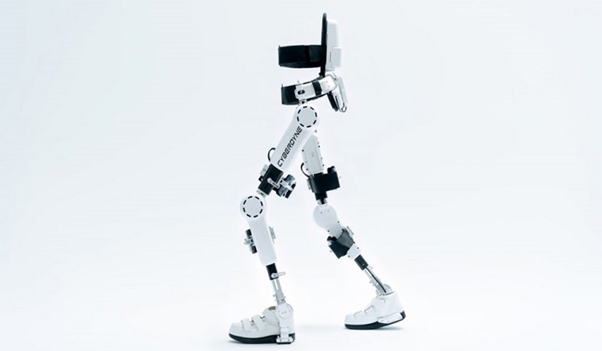
These exoskeletons use an advanced nerve-sensing system that mimic working of nerves in the human legs. Normally, when a person moves a limb, an electrical impulse is sent from the brain to the muscle. The exoskeleton’s in-built intelligence is able to detect these impulses on the surface of the skin, and its specially developed chips are able to digitize those signals and send the information in the form of commands to different parts of the exoskeleton. The centrally networked system powered by a system of electric motors, pneumatics, levers, hydraulics and combination of technologies make the necessary limb movement with increased strength and endurance.
Where can it be used?
The marketplace is witnessing introduction of a wide range of exoskeletons for diverse functions – lightweight comfortable exoskeletons for safe and repetitive assembly work, single-joint exoskeletons to assist a limb for specific tasks, full-body powered suits for handling heavy loads in industrial settings, and so on. Here are some areas where their use is increasing in popularity:
Safety: In addition to improving worker safety and efficiency, exoskeletons can considerably reduce (by more than 20%) the incidence of back injury by ensuring and encouraging proper body posture. This can affect millions of workers throughout the world.
Medical: Wearable exoskeleton technology holds a lot of potential in the medical realm. Studies have shown that the faster a patient gets up and moving, the faster he recovers, and using exoskeleton it is possible. Exoskeletons can optimise weight shift and ensure the proper alignment and synchronization of both sides of the body.
Work: In addition to ensuring worker safety, exoskeletons could help check fatigue and increase productivity. Many tasks may appear to be simple, but they cause a person to be exhausted. Wearable exoskeletons could be the answer to help address issues associated with tasks that cause a quick build-up in fatigue and which lead to work errors and accidents,
Military: Beyond making a combat ready powered exoskeleton for use in active combat zone, there are still many other applications that are being considered. One of the more obvious ones is logistics. Many field bases do not have the cranes and forklifts. Here exoskeletons can assist soldiers with loading or unloading supplies.
In conclusion
Even if the current exoskeleton suits don’t bestow superhuman powers, they could be used for doing heavy physical jobs without pain or injuries, and in a safer way. Exoskeletons could also allow injured and disabled people get an opportunity to perform tasks that they thought they might never be able to do, thus giving them the opportunity to enter and stay employed in physically demanding occupations. Governments also could empower fire-fighter, disaster personnel and combat troops with protective exoskeletons. In short, exoskeleton technology has the potential to impact lives for the better.
-Dr Siddhivinayak Barve
Editor, ScienceNow Digital
