
Cycling Across Rivers & Floods
India has periodically faced severe flooding problems in several regions. During such calamities when transportation network is completely disrupted, low-cost amphibian bicycles could help people overcome tragedy and return to normalcy….
When Mohammad Saidullah was unable to meet his wife owing to overcrowded boats, he decided to find a permanent solution to his routine problem – he invented an amphibious bicycle, the one that could be used on land and water. His ‘Noor bicycle’ (named after his wife) became the talk-of-the-town overnight with the media world happily flashing the news across channels. Even President APJ Abdul Kalam lauded his ingenuity taking a serious note of his innovation and recommending it for defence use. Subsequently, Saidullah received the National Innovation Foundation (NIF) lifetime achievement award for it, and NIF acquired the bicycle for further studies and design development on the personal instructions of President Kalam.
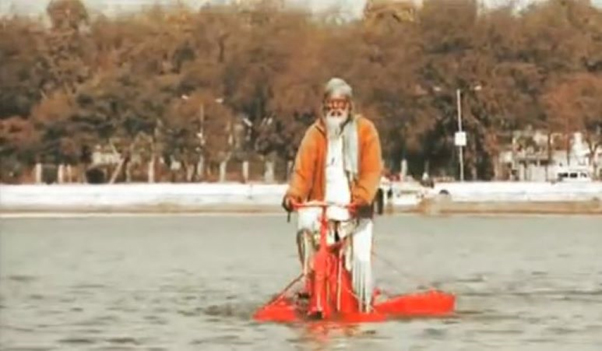
This may not have been the first time that someone passionately crossed the water hurdle against all odds to: meet his beloved, attend school, reach office or marketplace…But what makes the story unique is where others used their grit and determination Saidullah put his ingenuity to good use. Completely adhering to Greek philosopher Plato’s words, “Necessity is the mother of invention” Saidullah used his limited resources to find solution to a ‘universal’ problem. Certainly, it is this extraordinary spirit of Saidullah that motivated him to build a fan that runs without power, a mini-tractor for material transportation, a fodder cutter-operated centrifugal pump, a mini-turbine for electricity generation, etc.
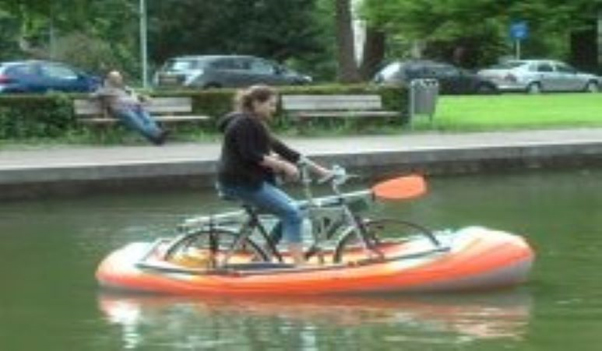
Amphibious Bicycle Design
Majority modern-day amphibious bicycle designs proposed by several grass-root innovators in India and abroad appear to be strikingly similar. To understand more about how amphibious bicycle designs have evolved over the years, we look at some of the popular designs:
- CYCLOMER BICYCLE: First introduced in 1932 by the French, who were then the helm of bicycle design and development across Europe, with some major structural changes in the bicycle design. Its looks were very different from those of the conventional bicycle, with front and rear buoyant bells as wheels. When in water, the bike gained its stability owing to the four smaller bells extended out from the bike’s frame.
- NOOR BIKE: The bike uses four rectangular air-filled metal floats for buoyance, and a paddle system in the rear wheel. These floats were made from recycled metal containers and are attached directly to the bike’s main frame. Here there is no major tinkering with the bike’s conventional design expect for the attachment of paddle to the rear wheel spokes.
- SHUTTLE BIKE: This project to build an all-weather, easy-to-carry amphibious bike was undertaken in 1992, near Milan in Italy. The Italian engineering company, SBK Engineering designed the Shuttle Bike with two inflated floats on either sides. The cyclist could carry the floats in his bag-pack while on land, and these could be inflated using pumps and then fastening it to the bicycle frame cross the water body. All the accessories and floats weighing approximately 11 kg could be easily dismantled in about 10-minutes and carried in a bag-pack.
Designing amphibious bicycle – Critical factors
- Buoyance: It is an upward force exerted by a fluid that opposes the weight of an immersed object. Moreover, the pressure increases with depth as a result of the weight of the overlying fluid. In short, an object experiences greater pressure at the bottom than at the top.
Buoyance force extended by the water on the bicycle while running in the water ought to be balanced, else it will be unstable or topple. The floats attached on either sides balance the buoyance force exerted while running in the water.
- Drag: It refers to forces acting opposite to the relative motion of the moving object with respect to a surrounding fluid. This force exists either between two different types of fluids or between a fluid and a solid surface.
Drag force balancing is critical while moving bicycle in the water. Invariably, the shape of the front float should be such that the bicycle experiences minimum drag force while moving. So also, the blades on the spokes of rear wheel should be designed in accordance to the drag force it experiences.
In Conclusion:
Designing of an affordable amphibious bicycle can help millions of poor people living in the flood prone areas across the globe overcome their day-to-day commuting problems, and probably, India stands to gain the most. The country is blessed with rich monsoon with several parts receive abundance of rain, eventually leading to flooding. During these periods of calamity, often there is a total breakdown of transportation services. People are forced to use boats, which are limited and scarce considering the population of those affected. The amphibian bicycle could prove to be an optimal solution, and its high time we dedicatedly worked on creating a truly world-class, low-cost “Indian Amphibian Bicycle’.
-Noel Fernandez
Team ScienceNow
