
At 430.5 meters below sea level, the Dead Sea is the lowest spot on Earth. The Sea bordered by Israel and Jordan has 34.2% salinity, making it one of the saltiest bodies of water in the world. This mineral- rich water and mud of the Dead Sea are believed to have numerous benefits for the body, especially for skin, respiratory and arthritic conditions. For this reason, many people visit the Dead Sea every year to get special treatments at the spas surrounding it…
Why ‘Dead’ Sea?
The sea is called deadbecause its high salinity prevents macroscopic aquatic organisms, such as fish and aquatic plants, from living in it. In times of flood, the salt content of the Dead Sea can drop from its usual 35% to 30% or lower. Being 8.6 times saltier than the ocean, the Dead Sea is so salty that fish cannot swim in it, boats cannot sail on it, and animals cannot survive around it.
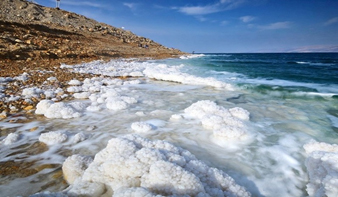
The Salt in the Dead Sea
People have visited the Dead Sea for thousands of years to experience its unique healing properties and to float in its dense, buoyant waters. Much of the freshwater feeding the Dead Sea has been diverted in recent decades, lowering the sea’s water levels and making it saltier than ever. Scientists first noticed in 1979, after this process had started, that salt crystals were precipitating out of the top layer of water, “snowing” down and piling up on the lake bed. The salt layer on the lake floor has been growing about 10 centimeters thicker every year.
Do you know?
Scientists believe that the Dead Sea will never disappear entirely. But by 2050 it will be the tipping point when the Sea will become so salty that the minerals will block water from evaporating, leaving a small pool of slimy sludge.
A Salty Mystery
As the Dead Sea has become saltier in recent decades, much of that salt has become concentratednear its surface. During the summer, extra heat from the sun warms the surface of the lake and divides it into a warm top layer sitting atop a colder lower layer. As water evaporates from the top layer in the summer heat, it becomes saltier than the cooler layer below. But then how was the salt from the surface building up at the bottom of the sea?
A new study by scientists proposes that disturbances caused by waves or other motion create tiny “salt fingers” across the surface of the lake that interact with one another as they funnel down to the lake bed, forming larger structures.
When the top layer of the lake is disturbed by waves or other motion, tiny parcels of warm water enter the cooler pool of water below. Heat diffuses more rapidly than salt, so this warm water parcel rapidly cools. As it cools, salt precipitates out and forms crystals that sink to the bottom. The researchers created a computer simulation of the salt fingers theory. And indeed, the theory correctly predicted the downward flow of salt snow and build up of salt layers in the middle of the lake’s floor.
-Dr Siddhivinayak Barve
Editor, ScienceNow Digital
