
Know Geology…
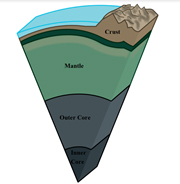
Earth’s Interior
Our mother Earth is formed around 2.5 billion years ago.
The Earth was a hot ball of molten rocks at the time of her formation. She gradually cooled down
from the surface inside, and currently is comprised of three distinct layers; the crust, mantle, and
core. Let us understand each of the layer in detail.
Crust: The Earth’s crust is the outermost layer of the Earth. Generally, the crust comprises
of only first 100 km of the Earth’s interior. That is not even 2% of the total thickness of the
Earth’s interior. But all the mining operations take place in this layer itself. This is because
we do not yet possess the technology to drill deeper than even 15 km into the Earth’s interior
(the deepest human interaction as of today is the Kola Superdeep Borehole, Russia (~12.3
km)). This crust can be divided into two types; continental crust and oceanic crust. As the
name suggests, the continental crust carries the continents, while the oceanic crust hosts
oceans. The continental crust can be further divided in three layers. The first layer is 2 km
thick, and is the lightest among them, with rock density approximately 2,200 kg/m 3 . This
layer mainly comprises of sedimentary rocks. Important outtake from this layer is the soil we
use for agriculture. The second layer goes up to 30 km depth, and comprises mainly of silica
and alumina. Thus, this layer is also called as SIAL. Third layer reaches to boundary between
the crust and the mantle, and mainly consists of silica and magnesia, earning it the name
SIMA. Density of the rocks in this layer increases up to 2,800-3,000 kg/m 3 . This layer mainly
comprises of igneous rocks.
Mantle: The second layer, the mantle, starts under the crust, and extends up to 2,900 km
depth. The boundary between crust and mantle is called ‘Mohorivicic Discontinuity’. The
mantle can be divided into two regions; upper mantle and lower mantle. The boundary
between the upper and lower mantle is located approximately at 700-800 km depth. The
upper mantle can even further be divided into two layers, the first being the crazy one. This
layer is called ‘Asthenosphere’. Asthenosphere means a layer of week particles. The
asthenosphere is in the plastic state, instead of solid state. It means that the asthenosphere
changes its shape according to the forces from the crust and mantle around it. Despite of the
plastic state, the asthenosphere is able to bear the load of the crust. The reason behind this is
the difference in densities. In the mantle, the density of rocks increases from 3,300 kg/m 3 in
the beginning to 5,700 kg/m 3 in the end. Therefore, the lighter crust floats on the denser
asthenosphere. The lower mantle is in the liquid state due to extreme heat. Mantle is also the region, where the subducted continental places arrive. Due to the heat and pressure, the plates
melt, and are added to the Earth’s magma supply. This magma again reaches the Earth’s
surface through volcanic eruptions and forms igneous rocks. Therefore, the mantle works as
a furnace, where the utilized crust materials are recycled.
Core: The Earth’s core begins at the end of the mantle, and extends up to the center of the
Earth. Boundary between the mantle and the core is called ‘Gutenberg Discontinuity’. The
core can be identified by the steep increase in the rock densities. The density of rocks, which
was 5,700 kg/m 3 at the conclusion of the mantle, suddenly increases to 9,900 kg/m 3 . The
density keeps increasing as we go even deeper, and it maxes out at 13,000 kg/m 3 at the center
of the Earth. The core is made of iron and nickel, and the movement of iron and nickel
particles in the core results in the formation of convection currents. These convection
currents ultimately form the Earth’s magnetic field, or magnetosphere. The core can be
divided into two regions; outer core and inner core. The outer core starts its regime from
2,900 km depth, and extends up to 5,150 km depth. Inner core covers the rest of the thickness
of the Earth’s interior. Inner core is in reality the hottest, but still in solid state, due to
compressive pressure from surrounding crust, mantle and outer core.
The difference in the rock densities throughout the Earth’s interior can be found by sudden
change in the properties of seismic waves.
-Ninad Bhagwat,
Montana Tech University, USA
