
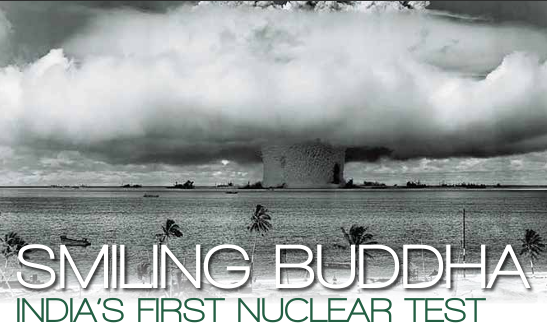
After the war against Pakistan in 1971, the then Prime Minister, Indira Gandhi who was touring the Bhabha Atomic Research Centre (BARC) in September of 1972 approved of a nuclear test. Without any hesitation, Physicist Raja Ramanna and chief of BARC at that time, took a team of around 75 scientists to design and build the plutonium implosion device.
The test was kept as secretive as possible and all the work on the project was carried under great secrecy. Successful test The Indian Army was given the work to dig a test shaft of about 330 feet underground at the Pokhran test site, Rajasthan. On May 18, 1974, the 1360 kilograms device exploded with a force equivalent to 8 kilotons of TNT.
Immediately after the test was conducted, Ramanna reportedly informed Indira Gandhi of the successful test through a coded message: “The Buddha is smiling.” Although officially known as Pokhran I, the 1974 test was informally named ‘Smiling Buddha.’
A number of countries condemned India’s nuclear test. While Canada pulled its support for the Indian nuclear program shortly afterwards; United States considered the test a violation of the Atoms for Peace program and responded with sanctions against India.
Superpower
After its successful nuclear test of 1974, India took more than 20 years to build a nuclear arsenal and delivery system capable of military deployment. Despite many challenges, the BARC leadership managed to construct their biggest nuclear plant till date—the Dhruva reactor at
Trombay in 1977, which would produce most of the plutonium for India’s nuclear weapons program.
The Indian government also approved a ballistic missile program in 1983. Over the next decade, the Defense Research and Development Laboratory (DRDL) built the short-range Prithvi missile and the long-range Agni missile.