
The Space Junk
According to the latest report, there are more than 200 million pieces of debris orbiting around the Earth, putting our working satellites at risk…
At present there are hundreds of man-made objects circulating our planet Earth. These objects which move at a speed of over 22,300 mph, faster than a speeding bullet can put our working satellites in grave danger. And these small fragments can leave huge dents in several satellites, telescopes, and other objects orbiting our planet. In 2006, for instance, a tiny piece of space debris collided with the ISS, creating a big dent in a heavily reinforced window.
There are more than 125 million pieces of debris smaller than 1 cm, about 900,000 pieces of debris 1–10 cm, and around 34,000 of pieces larger than 10 cm were estimated to be in orbit around the Earth. Most of these debris float within 1,250 miles of Earth's surface in what is known as low Earth orbit, home to a number of satellites, such as NASA’s Earth Observing System fleet and the International Space Station (ISS). And while space is big, this space junk can be problematic for active earth satellites because of their swift speeds.
What is this space junk?
Space debris began to amass in Earth’s orbit immediately with the first launch of an artificial satellite (Sputnik 1) into orbit in 1957. Immediately after that the North American Aerospace Defense Command (NORAD) began compiling a database of all known rocket launches and objects reaching orbit: satellites, protective shields and upper- and lower-stage booster rockets. Although it heralded a new beginning in the Space Age, with over 8,900 satellites from more than 40 countries launched so far, it left a mark in space in the form of junk.
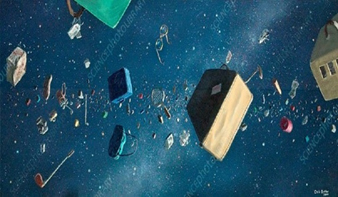
And this space junk mostly comprises of stages from rockets that put satellites into orbit and satellites itself after it becomes dysfunctional. In addition, it includes small pieces of junk lost to space which includes nuts and bolts, screwdriver, garbage bags and more. But the number has increased significantly recently with China and India testing their anti-satellite missile, creating at least 400 pieces of debris, which have further increased the risk of impacts to the ISS and other satellites orbiting the space.
With our skies becoming overcrowded with scientific and commercial satellites, it is high time countries need to work towards curbing the growing problem.
Cause for Concern?
There is all possibility that some of the junk will lose altitude over time and burn up in the Earth’s atmosphere. Despite this, there is still a lot of junk up there. Even without launching new satellites or major explosions, the space debris in Earth’s low orbit is so huge that it will continue to create problem over the centuries.
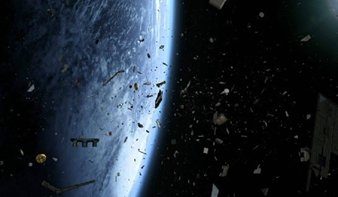
Reports suggest that over the next 200 years or so, debris larger than about 8 inches will increase by 1.5 times. And smaller trash will increase even more! Junk between 4 inches and 8 inches is expected to multiply 3.2 times and debris less than 4 inches will grow by a factor of 13 to 20. And this is likely to increase in future as more space programs have already been planned by various nations.
Precautions
Although many space agencies and private space firms have come out with various concepts, it still seems to be a distant dream. For example: JAXA, Japans space agency, is testing an electronic space whip that stretches six football fields long, known as the electrodynamic tether (EDT). The electrified line, nearly 2,300 feet long, is capped with a 44-pound weight. When deployed, it is intended to knock debris out of orbit, sending it to burn up in Earths atmosphere. Other options include giant magnets, harpoons, and nets to safely cut down the growing debris cloud.
Many countries are also developing plans to ensure that any future man-made satellites sent into space have an appropriate “end-of-life plan” to stop the growing menace of debris that float above our planet.
Manoj Mahanta
-Team ScienceNow Digital
