
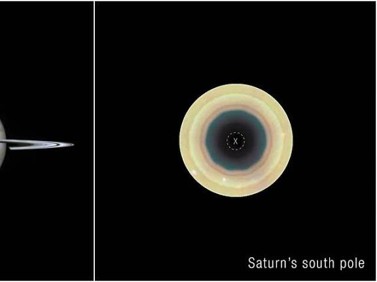
NASA’s Hubble Space Telescope has captured new images of a remarkable feature surrounding Saturn: a vast, 10-sided atmospheric wave known as the north polar hexagon. The enormous pattern, first discovered by the Voyager spacecraft in 1981, is a powerful jet stream encircling Saturn’s north pole.
Hubble’s observations show that the hexagonal jet stream remains a persistent feature of Saturn’s atmosphere, despite changing seasons on the planet. The structure is far larger than Earth, extending tens of thousands of kilometres across, while its winds race around the pole at hundreds of kilometres per hour.
Scientists believe the hexagon is produced by complex atmospheric dynamics, with Saturn’s rapid rotation and powerful jet streams playing key roles. Unlike a storm with a clearly defined centre, the hexagon is a long-lived atmospheric circulation pattern.
Hubble’s long-term observations are helping researchers understand how Saturn’s atmosphere changes over time. Studying this extraordinary wave also offers scientists a natural laboratory for understanding atmospheric flows on giant planets and, potentially, worlds beyond our Solar System.