science share account_circle

Author: sn_admin

  • India Rising

    India Rising

    Memoirs of a Scientist

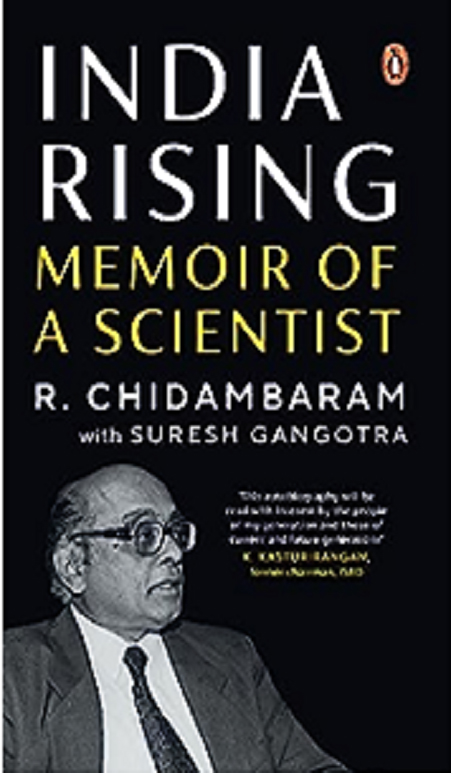
    As we celebrate the Independence Day… a rare celebration in the form of a Book titled India Rising…unfolding memoirs of a Scientist none other than Dr Chidambaram has been published…

    Dr. Chidambaram is one of the tallest figures, not only in the Department of Atomic Energy but also in Science in India. He has been at the helm of many institutions and organisations including the Principal Scientific Adviser to the Government of India. It is indeed welcome that he has penned his journey in the form of this book.

    The book covers his long journey, his greatest contribution is in the Peaceful Explosion Experiment tests in 1974, and then the Nuclear tests in 1998. These two landmark events have changed the course of not only the Department of Atomic Energy, but also of the nation

    India and particularly the Department of Atomic Energy works closely with International Atomic Energy Agency, with its headquarters at Vienna. Dr. Chidambaram has held the chair of Board of Governors of IAEA. During his tenure he has not only advanced the cause of the Agency, but also taken care of India’s interest. He narrates his experience with additional inputs from Dr. Raghuraman.

    He has served as Principal Scientific Adviser to the Government of India for 17 years. During his tenure, he has initiated many projects. Of particular interest are the national knowledge network, and the Rural Technology Action Group. He is passionate about identification and development of gifted children. The book covers various aspects of science like interdisciplinary aspects of science, importance of basic science, women in science and so on. During his long tenure, he has worked with many prime ministers. There is an interesting account on his interactions with the prime ministers.

    He has played a key role in opening up of the nuclear trade with the world. Post 1998, this needed a lot of work, including understanding of the world order and India’s unique position. In the present book Ambassador D.B. Venkatesh Verma has provided a fascinating account of Dr. Chidambaram as a diplomat.

    .The book encompasses the journey of science of India since Independence, is a great treasure of information that will serve as motivation to the young children and students, of not only science but also national history.

    -Dr Suresh Gangotra

    Co-Author, India Rising


  • Star Watch August

    Star Watch August

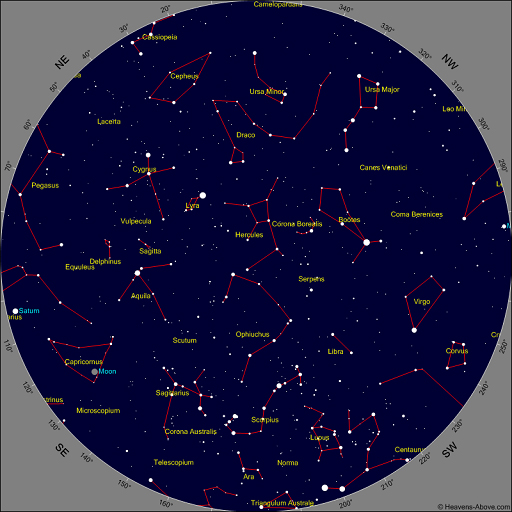
     This star chart is for early August 9 pm mid  August pm and end August  7 pm .

    To use this chart, hold the star chart vertically ,face any direction in the sky.

    Turn the star chart around so that the direction you are facing is at the bottom. Now, the stars shown at the bottom in the chart are the stars you will see in the sky .

    Dots represent stars. The larger the dot the brighter the star.


    Lines between stars are imaginary and aid location .Names of constellation are  along each side. 


    Monthly phases

    Full moon

    02 August 2023 00:02

    Last quarter

    08 August 2023 15:59

    New moon

    16 August 2023 15:08

    First quarter

    24 August 2023 15:27

    Full moon

    31 August 2023 07:06


    -Suhas Naik-Satam

    Nehru Planetarium 


  • Science Calendar August

    Let’s get acquitted with the Science Happenings in the month of August…

    August 1 – 1941:

    The first Jeep rolled off the assembly line, and Willy’s Truck Company was the first company to create a jeep.

    August 2 – 1932:

    The positron (antiparticle of the electron) is discovered by Carl D. Anderson

    August 3 – 1958:

    The nuclear submarine USS Nautilus travels beneath the Arctic ice cap

    August 6 – 1945:

    An American B-29 warplane, dropped atomic bomb named as ‘Little Boy’ on the Japanese city of Hiroshima.

    August 7- 1944:

    The world’s first program-controlled calculator, popularly called the Harvard Mark I, was inaugurated. The machine was built by Harvard researcher Howard Aiken and supported by IBM.

    August 8 – 1911: T

    he millionth patent is filed in the United States Patent Office by Francis Holton for a tubeless vehicle tire

    August 9 – 1898:

    Rudolf Diesel of France was granted patent Number 608,845 for an “internal combustion engine” known as the Diesel engine.

    August 10 – 1990:

    The Magellan space probe reaches Venus.

    August 11 – 1942:

    Hedy Markey received a patent for a secret communication system.

    August 12 – 1851:

    Isaac Singer is granted a patent for his sewing machine.

    August 13 – 1913:

    Invention of stainless steel by Harry Brearley

    August 14 – 1984:

    IBM released MS-DOS version 3.0. IBM first approached Bill Gates and Microsoft to discuss the state of home computers in 1980.

    August 15 – 1977:

     The Big Ear, a radio telescope operated by The Ohio State University as part of the SETI project, receives a radio signal from deep space.

    August 16 – 1989:

     A solar flare from the Sun creates a geomagnetic storm that affects microchips, leading to a halt of all trading on Toronto’s stock market.

    August 17 – 1970:

    Venera Program: Venera 7 launched. It will later become the first spacecraft to successfully transmit data from the surface of another planet (Venus).

    August 19 – 1837:

    Louis Daguerre and Joseph Nicephore had developed Daguerreotype, which was first photographic process. The patent of Daguerreotype was purchased by the French government.

    August 20 – 1858:

    Charles Darwin first publishes his theory of evolution in The Journal of the Proceedings of the Linnean Society of London, alongside Alfred Russel Wallace’s same theory

    August 21 – 1888:

    The first practical adding & listing machine (calculator) was patented by William Burroughs.

    August 22 – 1952:

    The Television Show “Adventures of Superman” was copyright registered.

    August 23 – 1966:

    Lunar Orbiter 1 takes the first photograph of Earth from orbit around the Moon.

    August 24 – 2006:

    The International Astronomical Union (IAU) redefines the term “planet” such that Pluto is considered a dwarf planet.

    August 28 – 1859:

    A geomagnetic storm causes the Aurora Borealis to shine so brightly that it is seen clearly over parts of USA, Europe, and even as far afield as Japan

    August 31 – 1897:

    Thomas Edison patented a kinetographic camera.

    -Team ScienceNow

  • NO MOBILES

    The UN’s education, Science, and Culture agency, UNESCO, has said that smartphones should be banned from schools. The UN body’s statement hints to tackle classroom disruption and change the growing acceptance of digital education as a replacement for face to face teaching-learning process

    The 2023 Global Education Monitoring Report has just released a call for technology only to be used in class when it supports learning outcomes, and this includes the use of smartphones.

    The digital revolution holds immense potential but, just as the warnings is voiced for how it should be regulated in society, more attention must be paid to the way it is used in education.

    The report shows that some technology can support some learning in some contexts, but not when it is over-used or inappropriately used. In particular, the use of smartphones can disrupt learning in classrooms. One study conducted at pre-primary through to higher education in 14 countries found that it distracted students from learning. A mobile phone nearby with notifications coming through is enough to result in losing attention from the task.  The study found that it can take students up to 20 minutes to refocus again. 

    Almost one in four countries introducing bans on smartphones use in schools. In countries like Belgium, Spain and the United Kingdom was found to improve learning outcomes. Bangladesh and Singapore have also banned smartphone use in class.

    The new 2023 GEM Report, entitled ‘Technology in education: A tool on whose terms?’, calls for decisions about technology in education to prioritize the needs of the learner, making sure that any uses of technology are appropriate, equitable, scalable and sustainable.

    -Dr Siddhivinayak Barve

    Editor, ScienceNow Digital

  • Editorial

    Editorial

    Greetings from ScienceNow Digital….

    This month is marvellous in the history of Indian Science. The month is special as it has the historic moon landing date.. In Indian context the spectacular launch of Chandrayan III will be noted in history as the month in which most ambitious project of ISRO… Chandrayan is launched.

    ISRO has established itself as the most successful space research organization in the world… The dream of the visionary, father of Indian Space Programme Vikram Sarabhai, is translated to reality… showing the world the power of India’s Space Programme with the indigenously developed technologies by our scientists.

    India is aiming to soft land on the moon and run a rover.. the coveted fete will put India to be just the 4th such nation in the world to have such a technology.. Furthermore, India will be the first country to explore the south pole territory of the lunar surface.

    India, in its previous space missions has established the meritorious trail by proving the presence of water on lunar surface. The current mission, with its scientific findings, will again make history by mapping the moons south pole, this will be a unique achievement…We are waiting for the touchdown of the mission moon…

    This issue is dedicated to India’s Mission Moon, besides this all the regular features are presented.

    India is making rapid strides in Science and Technology and now regarded as one of the most promising Science and Technology happening destination… Our endeavour is to bring the best in Science and Technology through ScienceNow Digital to present science to the masses…

    ScienceNow will be with more power packed material in the coming months… we are revamping our website and soon we will be on the app store too… ScienceNow Digital will have a wider reach.

    ScienceNow Digital with its commitment to bring Science and Technology, will leap forward with your support, keeping up the promise of bringing out excellence in Science…

    Scientifically yours


    Dr Siddhivinayak Barve

    Editor,

    ScienceNow Digital


  • Science News

    That happened in Science This Month… A collection of Science News

    Irrigation may be shifting Earth’s rotational axis

    Runoff from irrigation has moved so much water from land to sea that Earth’s rotation might have measurably shifted. Computer simulations suggest that from 1993 through 2010, irrigation alone nudged the North Pole by about 78 centimeters, making irrigation the second largest contributor to polar drift after the ongoing rebound of Earth’s surface following the retreat of glacier.
    Previous studies have suggested that irrigation shifted about 2 trillion metric tons of water from land-based aquifers to the oceans from 1993 through 2010 — enough to raise global sea level more than 6 millimeters. Although seemingly minuscule, that redistribution of water was enough to shift the North Pole just over four centimeters each year on average during that period, the team found. When all sources of water movement are considered — including the runoff of melt water from the Greenland and Antarctic ice sheets — the North Pole drifted about 1.6 meters toward the east coast of Greenland in that time.
    Physicists split bits of sound using quantum mechanics

    Physicists have now turned to quantum effects to split phonons, the smallest bits of sound. The achievement may one day lead to sound-based versions of quantum computers or extremely sensitive measuring devices. Phonons have much in common with photons, the tiniest chunks of light. Turning down the volume of a sound is the same as dialing back the number of phonons, much like dimming a light reduces the number of photons. The very quietest sounds of all consist of individual — and indivisible — phonons.

    Unlike photons, which can travel through empty space, phonons need a medium such as air or water. Phonons can’t be permanently broken into smaller bits. But, as the new experiment showed, they can be temporarily divided into parts using quantum mechanics.

    The feat was achieved with an acoustic beam splitter, a device that allows about half of an impinging torrent of phonons to pass through while the rest get reflected back. But when just one phonon at a time meets the beam splitter, that phonon enters a special quantum state where it goes both ways at once. The simultaneously reflected and transmitted phonon interacts with itself, in a process known as interference, to change where it ultimately ends up.
    Satellite beams solar power down to Earth

    The California Institute of Technology (Caltech) researchers have taken a small but necessary step toward realizing a long-standing dream: harvesting solar energy in space and beaming it down to Earth. A satellite launched in January has steered power in a microwave beam onto targets in space, and even sent some of that power to a detector on Earth. The transmitted power was small, just 200 milliwatts, less than that of a cellphone camera light. But the team was still able to steer the beam toward Earth and detect it with a receiver at Caltech.

    To produce as much power as a typical coal or nuclear power station, a satellite would need a collecting area kilometers across, requiring hundreds of launches and assembly in orbit. NASA planned a demonstration mission during the 1970s energy crisis. Space has changed since then. Solar cells and microwave beams are cheaper and more efficient. Robots capable of assembling structures will soon be in orbit, and companies such as SpaceX have slashed the cost of launches. Recent studies commissioned by ESA and the U.K. government suggest giant orbiting generators will soon be able to generate electricity at costs comparable to earthbound nuclear plants.

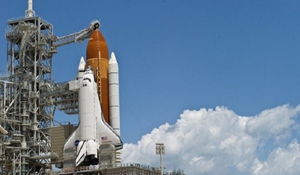
    Space shuttle Endeavour to be displayed vertically
    The 20-story tall display will show the shuttle as it would appear waiting on a launch pad. Endeavour was built as a replacement for the destroyed shuttle Challenger and flew 25 missions between 1992 and 2011. The shuttle will be moved across Exposition Park and lifted by a crane to be intricately mated to the external tank. Construction of the Air and Space Center will be completed around the full shuttle stack. The center’s foundation has raised $320 million of the $400 million goal for the project. Exposition Park is between the University of Southern California and Los Angeles Memorial Coliseum.

    When NASA’s shuttles were retired, Endeavour was flown to California atop NASA’s special Boeing 747 shuttle carrier in 2012. After landing at Los Angeles International Airport, the shuttle inched through tight city streets to the California Science Center over several days. Dec. 31 will be the last chance to see Endeavour as it has been displayed horizontally in the landing position for years since arrival at the center.

    James Webb Telescope finds most distant supermassive black hole

    The James Webb Space Telescope has made a groundbreaking discovery, revealing the most distant supermassive black hole ever observed in the universe. This enormous black hole is estimated to be 90 million times the mass of our Sun, making it a truly colossal structure. It was found to have formed 570 million years after the big bang, a significant period in cosmic history. The black hole in question resides within the galaxy CEERS 1019, where astronomers have also identified two smaller black holes that formed 1 and 1.1 billion years after the big bang. Notably, the black hole within this galaxy is comparatively less massive than others detected in the early universe.

    Utilizing the power of the world’s most advanced observatory, the James Webb Space Telescope acquired near- and mid-infrared images, as well as valuable spectral data, to uncover these remarkable findings. The telescope’s unique ability to capture high-quality observations in the darkness of space has played a crucial role in this breakthrough. Supermassive black holes represent a distinct type of black hole that resides at the cores of galaxies. They far exceed the size and mass of regular stellar black holes formed from massive star collapses. These supermassive black holes possess an incredible mass range, reaching millions to billions of times the mass of our Sun.

    IIT-Hyderabad researchers tune in to humming of the universe

    Researchers from the Indian Institute of Hyderabad (IITH) have found evidence of the humming of the universe. These results provide a hint of evidence for the relentless vibrations of the fabric of the universe, caused by ultra-low-frequency gravitational waves. The researchers were part of an international collaboration that monitored pulsars, nature’s best clocks. The team from India, Japan, and Europe used six of the world’s most sensitive radio telescopes, including India’s largest telescope uGMRT, to tune in to the vibrations coming from deep space. Astronomers call these vibrations nano-hertz gravitational waves as their wavelengths can be many lakhs of crores of kilometers.

    Gravitational waves, a phenomenon predicted by Albert Einstein’s theory of general relativity, have revolutionized our understanding of the universe. These ripples in the fabric of spacetime are generated by the most powerful cosmic events, such as the collision of black holes or the merging of neutron stars. Listening to gravitational waves opens up a new window into the cosmos, providing invaluable insights into the nature of black holes, the formation of galaxies, and the evolution of the universe itself. Gravitational wave detectors allow us to observe phenomena that were previously invisible to traditional telescopes, offering a complementary perspective on cosmic events.

    Astronauts’ entirely recycle liquid waste into drinking water

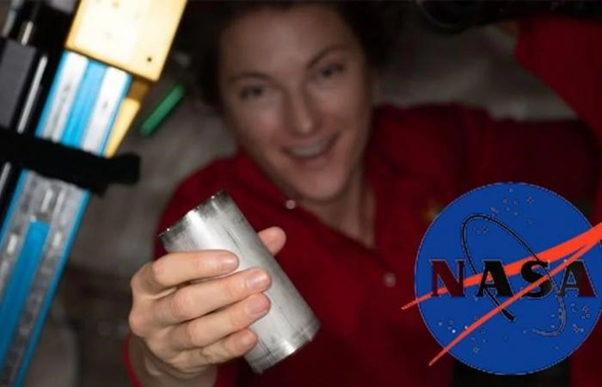
    Scientists have achieved a clear win on the International Space Station as they have managed to filter nearly all of the astronauts’ wastewater with a new system that distills sweat, urine and other moisture in the cabin into clean drinking water. NASA said 98% of the wastewater on the space station was successfully recovered. That is a 3% to 4% increase from what the previous system was able to achieve. The new system is a multistep process, according to NASA, in which urine is first distilled through the Urine Processor Assembly. The process produces water and then some leftover “urine brine.”

    The water subsystems is similar to how water is processed on land but with the challenges of microgravity. In this case, the crew isn’t drinking urine — they are drinking water that is even cleaner than Earth’s. The less water and oxygen we have to ship up, the more science that can be added to the launch vehicle. The new system is a larger step in the evolution of technology that can help sustain life in space, which could help sustain longer missions without fear of losing essential supplies.

    Time moved 5 times slower for 1st billion years after Big Bang

    Shattering previous notions and providing further confirmation of Einstein’s theory of relativity, a ground breaking study has revealed time dilation effects in quasars. These celestial objects powered by supermassive black holes exhibit fluctuations in their emitted light. Through a new sample of 190 high-redshift quasars observed over 20 years, researchers were able to detect the time dilation effect in the variability of quasar light. The observations indicated that time in these quasars appear to run five times slower than on Earth. This breakthrough in detecting time dilation effects in quasars marks a significant achievement, especially considering previous unsuccessful attempts. Researchers utilized data from the Sloan Digital Sky Survey, Pan-STARRS, and the Dark Energy Survey to conduct a comprehensive study.

    The implications of these findings go beyond confirming the existence of time dilation. They provide valuable insights into the expansion of the universe. Over the course of 12 billion years, as the universe expanded, the light emitted by these quasars finally reaches us. However, during that time, the universe underwent significant growth. Therefore, when observing these quasars, we are essentially peering back in time, witnessing them as they appeared over 12 billion years ago.

    Baby without sperm or egg?

    In a major breakthrough in the world of In Vitro Fertilisation (IVF) and human reproduction, a team of scientists in the US and the UK has developed the world’s first ever synthetic human embryo-like structures using stem cells. According to the report by The Guardian (article beyond paywall), these embryos resemble natural embryos in the earliest stages of human development. While they lack a beating heart or the beginnings of a brain, they contain cells that would give rise to the placenta, yolk sac and the embryo. These models would also help scientists understand the impact of genetic disorders and the biological reasons behind recurrent miscarriages.

    However, the research also raises major ethical and legal consequences as the use of synthetic embryos for clinical purposes is not legally imminent in the UK and most other countries. Implanting them into a patient’s womb is currently illegal, and it remains uncertain whether these structures have the potential to progress beyond the earliest stages of development. Scientists at present are allowed to cultivate embryos in the lab for duration of 14 days. Those “embryoids” showed the beginnings of a brain, heart and intestinal tract after about eight days of development, the report added.

    Euclid space telescope to target universe’s ‘dark mysteries’

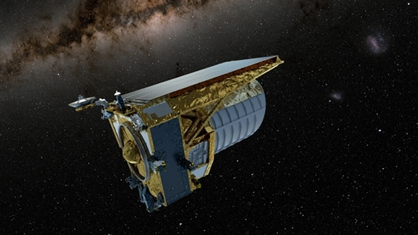
    After a month-long journey through space, Euclid will join its fellow space telescope James Webb at a stable hovering spot around 1.5 million kilometers (more than 930,000 miles) from Earth called the second Lagrange Point. From there, Euclid will chart the largest-ever map of the universe, encompassing up to two billion galaxies across more than a third of the sky. By capturing light that has taken 10 billion years to reach Earth’s vicinity, the map will also offer a new view of the 13.8-billion-year-old universe’s history. Euclid, which is 4.7 meters (15 feet) tall and 3.5 meters wide, will use two scientific instruments to map the sky. Its visible light camera will let it measure the shape of galaxies, while it’s near infrared spectrometer and photometer will allow it to measure how far away they are.

    Scientists hope to use this information to find an answer to what scientist call as a “cosmic embarrassment”: that 95 percent of the universe remains unknown to humanity. Around 70 percent is thought to be dark energy, the name given to the unknown force that is causing the universe to expand at an accelerated rate. And 25 percent is dark matter, thought to bind the universe together and make up around 80 percent of its mass. So how will Euclid try to spot things that cannot be seen? By searching for their absence. The light coming from billions of light years away is slightly distorted by the mass of visible and dark matter along the way, a phenomenon known as weak gravitational lensing.

    Mountain peaks three to four times higher than Mt. Everest found near Earth’s core

    Mountains with peaks three to four times higher than Mount Everest have been discovered deep inside the Earth in Antarctica. During the study, when researchers looked at seismic waves generated by 25 earthquakes, they found these waves inexplicably slowed down when they reached a jagged patch on the core-mantle boundary. This vast, otherworldly mountain range was highly variable – some peaks stretched 40km (24.8 miles) up into the mantle, equivalent to 4.5 times the height of Everest. Meanwhile, others were just 3km (1.7 miles) high.

    According to the researchers, the mountains are parts of the lower mantle that have been superheated due to their proximity with Earth’s incandescent core. While the mantle can reach 3,700C (6,692F), this is relatively mild – the core can achieve atom-bending highs of 5,500C (9,932F) – not far off the temperature at the surface of the Sun. The deep-Earth mountains could be made from a subtly different material to the surrounding mantle, suggested the report. Incredibly, it’s thought that they could be the remains of ancient oceanic crust which disappeared into its depths, eventually sinking down over hundreds of millions of years to settle just above the core.

    Global warming rate speeds up at 0.2 degrees celsius per decade

    Average annual emissions over the same period hit an all-time high of 54 bn tonnes of CO2 or its equivalent in other gases — about 1,700 tonnes every second. Record-high greenhouse gas emissions and diminishing air pollution have caused an unparalleled acceleration in global warming, 50 top scientists warned. From 2013 to 2022, “human-induced warming has been increasing at an unprecedented rate of over 0.2 degrees Celsius per decade,” they reported in a peer-reviewed study aimed at policymakers.Average annual emissions over the same period hit an all-time high of 54 billion tonnes of CO2 or its equivalent in other gases — about 1,700 tonnes every second.

    World leaders will be confronted with the new data at the critical COP28 climate summit later this year in Dubai, where a “Global Stocktake” at the UN talks will assess progress toward the 2015 Paris Agreement’s temperature goals. The findings would appear to close the door on capping global warming under the Paris treaty’s more ambitious 1.5C target, long identified as a guard rail for a relatively climate-safe world, albeit one still roiled by severe impacts.

    -Team ScienceNow

     

  • Reaching Stars… CHANDRAYAN III

    Reaching Stars… CHANDRAYAN III

    India has successfully launched its Moon Mission – Chandrayan -3 aiming to strike the first in landing on Moon’s South Pole

    ISRO has another feather in its cap … all set now for Reaching Stars

    The Chandrayaan-3 with its orbiter, lander and a rover lifted off from Sriharikota space centre.

    The lander will reach Moon on 23-24th August.

    India will be the fourth country to achieve a soft landing on the Moon, after the US, the former Soviet Union and China.

    Moon Missions

    The third in India’s programme of lunar exploration, Chandrayaan-3 is expected to build on the success of its earlier Moon missions. Chandrayaan-3 is a new chapter in India’s space odyssey

    India has a successful trail of Moon Missions in Chandrayan I and Chandrayan II

    Chandrayan I was launched in 2008 which carried the detailed search of Water on Lunar Surface and established that Moon has water on its surface

    Chandrayaan II was the next ambitious mission launched n July 2019  to land a rover on the lunar surface but the mission was partially successful. due to complications in the system. The rover could not land the moon, however the Chandrayan II Orbiter is still circling the moon.

    Chandrayaan III is the latest moon mission which is aiming to land on the moon, thereby making history with indigenously developed technology and becoming only the fourth country in the world to be able to achieve this distinction.

    India’s Pride

    The ambitious project is worth Rs 610Cr which weighs 3,900kg

    The moon lander is named Vikram after the legendary founder of ISRO, Vikram Sarabhai. The lander weighs about 1,500kg and it carries the moon rover Pragyaan, which means wisdom.

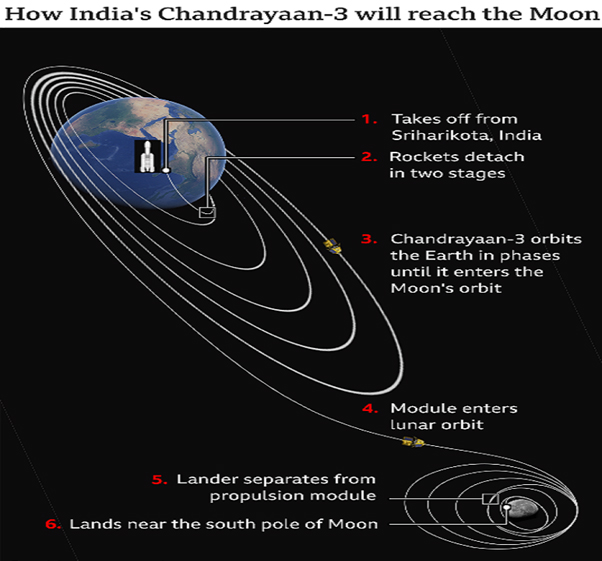
    Now after the spectacular lift-off the spacecraft will circle the earth for about 15 to 20 days and later enter the Moon’s orbit. On entering the lunar orbit, the speed of the spacecraft will be reduced for the soft landing of Vikram lander

    Moon Rover

    On soft landing the moon, the six-wheeled rover will roam the surface of the moon and send the images and crucial investigation data from the lunar surface. The Rover Pragyaan has five vital instruments to gather the data about the Physical characteristics of the Moons surface, its Atmosphere and the Geological Characteristics of Moon. The rover is a solar powered vehicle which will roam around the surface of the moon which is not visible from the earth..

    The orbiter from Chandrayaan II which is still successfully orbiting the moon, has been providing high-resolution images of the spot where Chandrayan III will land…

    The landing is aimed to be very precise and soft which will coincide with dawn of the lunar day…

    Aiming High

    Indian scientists are very keen to explore the South Pole of the moon, which is still unexplored fining out and reconfirming the earlier discovery of water in the south pole of the moon

    The scientists and people of India are waiting for the day to dawn as the Space Programe is a matter of pride for India…Moon will be the first step for Reaching to Stars… and after Chandrayan India has lot more to come in its ambitious Space Mission

    -Dr Siddhivinayak Barve

    Editor, ScienceNow Digital

  • India’s Mission Moon

    India’s Mission Moon

    The Indian Space Research Organization (ISRO) launched the Chandrayaan mission. While Chandrayaan 1 was successfully launched in October 2008, the Chandrayaan 2 mission was launched on 22 July, 2019.

    An insight into the missions that propelled India onto the global space platform

    India launched Chandrayaan 1 – its first mission to the moon on 22 October, 2008 from the Satish Dhawan Space Center in Sriharikota, Andhra Pradesh. The mission gave a major boost to India’s space program as India’s scientists researched and developed the country’s indigenous technology in order to explore the Moon.

    Chandrayaan 1

    Chandrayaan-1 was India’s first deep space mission and it lasted for 312 days. The mission is said to have mapped about 95% of the moon’s surface, with its biggest achievement being the detection of water on the Moon’s surface. NASA’s Moon Mineralogy Mapper (M3) on board of Chandrayaan-1 detected water and hydroxyl molecules on the surface soil and rocks on the Moon. Though the lunar probe was expected to remain in orbit and send data for two more years; on 29 August 2009 radio signals from Chandrayaan-I were lost and the mission was considered ended at that point.

    Ten years after this historic mission, ISRO embarked on another glorious launch with Chandrayaan 2…

    Chandrayaan 2 

    Chandrayaan-2 lifted off from Sriharikota at 2.43 p.m. on 22 July, 2019 on a Geosynchronous Satellite Launch Vehicle called GSLV-Mk II. In 17 minutes it injected into a geostationary orbit. The ₹978-crore mission is by far the biggest and most complex space mission for India.

    The Spacecraft

    The Chandrayaan-2 spacecraft comprised  a composite module consisting of an Orbiter, a Lander (Vikram), and a Rover (Pragyan). All three components were located in the heat shield of the GSLV MK III rocket – India’s most powerful launch vehicle which is entirely designed and made within the country. And at 3,853 kg, Chandrayaan-2 is the heaviest payload launched by an Indian rocket.

    The Objectives

    Chadrayaan-2’s voyage to the Moon was nearly 3.8 lakh km, lasting for 54 days. After approaching the 100 km lunar orbit, the Lander covering the Rover was to depart from the Orbiter.

    Some of the objectives of the mission were:

    • The primary objective of Chandrayaan-2 was to demonstrate the ability to soft-land on the lunar surface and operate a robotic rover on the surface.
    • The instruments on the rover to navigate across the site and perform a chemical investigation which included collecting various rock and soil samples to trace the origin and evolution of Moon.
    • The orbiter to map the lunar surface and help prepare its 3D maps. The on-board radar was to map the surface to find the possibility of craters that might contain fossilised records of the early solar system in this region.

    The Mission Mapping

    Chandrayaan 2 was in the Earth’s orbit for 23 days. On the 23rd day, scientists performed the ‘trans-lunar’ injection and Chandrayaan 2 was expected to make a soft-landing on the moon at 2.58 a.m. on
    7th September, 2019. It would also take India to where no country has stepped before – the South Pole of the Moon.

    The Challenge

    A soft landing on the Moon’s surface which is covered with craters, dust and rocks was the trickiest part for the mission. During the touchdown, the lander has to protect the delicate electronic components on board. After landing, the rover was to be slowly positioned over the course of four hours to explore and carry out experiments on the lunar surface for 14 earth days (1 lunar day) while the orbiter will continue its mission for a year.

    ISRO had lost contact with lander Vikram on September 7, 2019 as it was 2.1 km above the lunar surface, trying to soft-land on the unexplored South Pole of the Moon. It had a hard-landing very close to the planned touch-down site and while the lander is in a single piece, it is in a tilted position. The module was carrying rover Pragyan and three scientific instruments, meant to study the soil composition, atmosphere, seismic activity and other aspects of the environment around the landing site.

    Meanwhile its orbiter in lunar orbit with its eight payloads was to conduct remote-sensing observations for one year from a 100 km orbit above the Moon’s surface. It was the orbiter that had spotted Vikram on the lunar surface on September 8, 2019, making ISRO continue its efforts of re-establishing communication.

    Mission Highlights

    • Chandrayaan-2 was a three satellite missions stacked in a single launch. Out of the three, two systems – Vikram (lander) and Pragyan (rover) were completely new to ISRO.
    • The mission was led by Vanitha Muthayan as program director and Ritu Karidhal as mission director. This is the first time women have headed an interplanetary mission.
    • Till date 90 to 95% of the mission objectives have been accomplished and will continue to contribute to lunar science, notwithstanding the loss of communication with the Lander.

    Do you know?

    The lander of Chandrayaan – 2 is named ‘Vikram’ in honour of Dr. Vikram Sarabhai – the father of the Indian Space program. The rocket GSLV Mk III is also nicknamed “Bahubali”.

    -Dr Siddhivinayak Barve

    Editor, ScienceNow Digital

  • Lander and Rover

    Lander and Rover

    Spectacular launch of the Chandrayan III will take to the moon, the most ambitious experiment of the moon mission. India is aiming to soft land on the moon and perform certain experiments with the moon rover. The lander is named Vikram and the Rover is called Pragyan

    A propulsion module will carry the lander-rover configuration to a 100-km lunar orbit. Once the ‘Vikram’ lander module makes it safely to the moon, it will deploy ‘Pragyan’ which will carry out in-situ chemical analysis of the lunar surface during the course of its mobility

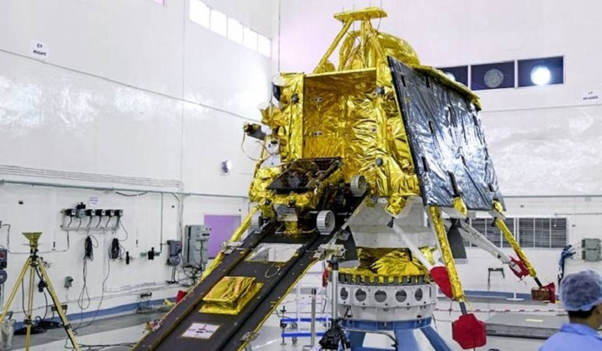
    Vikram – moon lander with slight modification in leg strength will help payloads from Chandrayan 3 to land on Moon

    The lander will ensure soft landing of the rover and other payloads about 70 degrees from the Moon’s south pole. The lander and propulsion module will detach from the spacecraft when it reaches an orbit 100 x 100 km away from the surface.

    Vikram lander features a new instrument to precisely calculate the spacecraft’s descent speed, stronger legs to handle a higher landing speed, and a wider landing site of 4km by 2.5km.

    Once the lander and propulsion module are separated from the spacecraft, the latter will steer the ensemble from launch vehicle injection orbit to lander separation.

    The technologies used in this process will help in other inter-planetary missions. India, in June 2023, signed Artemis Accords with NASA which will determine the parameters of human space flight missions. This Chandrayan 3 mission would turn out beneficial for such future missions.

    Scientific experiments

    The lander, rover and the propulsion module will have payloads for performing experiments designed to give scientists new insights into the characteristics of earth’s lone natural satellite.

    The lander will have four payloads — Radio Anatomy of Moon Bound Hypersensitive ionosphere and Atmosphere (RAMBHA), Chandra’s Surface Thermo physical Experiment (ChaSTE), Instrument for Lunar Seismic Activity (ILSA) and the LASER Retroreflector Array (LRA).

    The six-wheeled rover will have two payloads — the Alpha Particle X-ray Spectrometer (APXS) and the LASER Induced Breakdown Spectroscope (LIBS).

    India will be the first country to map the south pole of the moon. The mission will be a leap forward for the Indian Space Programme

    -Dr Siddhivinayak Barve

    Editor, ScienceNow Digital

  • Indian Space Research Organization

    Indian Space Research Organization

    “The development of the nation is intimately linked with understanding and application of science and technology by its people.” – Dr. Vikram Sarabhai

    The space research activities were initiated in India during the early 1960’s. Dr. Vikram Sarabhai – the founder of the Indian space programme, envisioned that space research would help address the needs of humankind and lead the nation to progress.

    Inception of Space program

    Dr. Sarabhai summoned brilliant scientists, anthropologists, communicators, environmentalists and engineers from across the nation to build the Indian space programme that focused on building satellites for communication and remote sensing, space transportation system and application programmes.

    He set up the Thumba Equatorial Rocket Launching Station (TERLS) which pioneered the manufacturing sounding rockets in India. He also initiated Satellite Instructional Television Experiment (SITE) so as to transmit education to remote regions across India. The Government of India set up the Indian National Committee for Space Research (INCOSPAR) under the leadership of  Dr. Sarabhai and Dr. Ramanathan. The first Experimental Satellite Communication Earth Station (ESCES) that was set up in 1967 also became a training centre for Indian and international scientists and engineers.

    Setting up of ISRO

    The time was ripe to harness space technology for India’s development. In 1969, the Indian Space Research Organisation (ISRO) replaced INCOSPAR. The Satish Dhawan Space Centre was formed in Sriharikota, Andhra Pradesh in 1971. The following year, the Department of Space (DoS) was established and ISRO was brought under it. It was now crucial to set up a satellite system that can contribute to the national development. In 1980, ISRO successfully launched its own satellite Rohini-1 from Sriharikota. The launch enlisted India as the eight nation to prove its space technology prowess.

    Leap of success

    Today, space technology in India has brought immense progress and added the nation into an elite club of developed countries. India has become the sixth largest space agencies in the world. ISRO maintains one of the largest fleet of communication satellites (INSAT) and remote sensing satellites (IRS) for reliable communication, earth observation, satellite navigation, climate and environment. ISRO has also developed two satellite launch vehicles – PSLV and GSLV to place satellites in the Earth’s orbits. The vehicles have become favoured satellite carriers by other nations, thereby fostering international associations.

    Contribution towards education

    Apart from technological capability, ISRO has immensely contributed to science and education by initiating several autonomous institutions and research centres, promoting studies in astronomy, astrophysics, atmospheric sciences and space sciences. ISRO’s massive lunar missions (Chandrayaan 1 & 2) and planetary mission (Mars Orbiter Mission) has encouraged scientific study and research, further promoting valuable data to the scientific community.

    Future ready

    With technology as the key to future, ISRO adheres to optimise its development of launchers, human spaceflight projects, reusable launch vehicles, semi-cryogenic engines, orbit vehicles, development and use of composite materials for space applications etc. From the humble beginnings to the massive missions, ISRO has grown as an institution of space research.

    Manoj Mahanta

    ScienceNow Digital