science share account_circle

Author: sn_admin

  • Innovation – The Serial Inventor

    Innovation

    The Serial Inventor

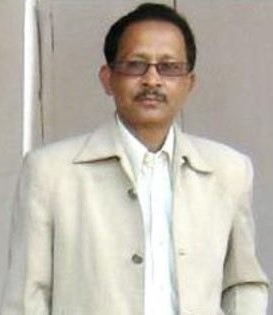
    Padma Shri Uddhab Bharali from Assam has over 150 inventions under his belt, and continues to make life easier for people through his machines…

    A grass root innovator from Assam, today Uddhab Bharali is known for more than 150 innovations to hisname such as paddy thresher, cane stripping machine, pomegranate de-seeder and low-cost incinerator.

    How did it all start?

    While Bharali was good at academics, the engineering aspirant had to drop out of college during his final year owing to financial hardships. To help his father in repaying debts, he experimented with innovation and developed new tools — an interest that Bharali had, even as a child.

    However, his first innovation came in 1988, when he developed a polythene making machine for the tea industry. Till then, Lakhimpur in Assam was a zero industries district, and at the time only the tea industry was booming. They required polythene covers in bulk and instead of buying a machine which would cost him lakhs of rupees, Bharali developed his very own for about Rs 65,000.
    The beginning…

    The success of the polythene cover making machine gave him the confidence he needed. To come upwith his innovative products, Bharali, like many others, relied on ‘jugaad’ where he used cheap, easy to find materials to develop products which are sustainable and efficient. By 1995, Bharali had paid-off all his father’s debt and got a job of looking after the machinery used in a hydropower project in Arunachal Pradesh. But it was short lived as he had to return back to his hometown after the news of his elder brother’s death.

    Realising he was the only bread earner for his family, Bharali had to make ends meet. Between the 1990s and mid-2000s, he developed 24 products which focused on helping farmers. Though Bharali wanted to develop or innovate for other sectors too, but the demand was huge from the farm sector.

    From developing different kinds of peelers, re-designing Assamese paddy grinder to cutters for tea- leaves, he took extra effort to simplify agricultural processes for the farming community. Identity as an inventor

    Bharali’s ultimate recognition came in 2006, but not before the serial inventor designed and prototyped an entire range of mechanical innovations. Bharali’s pomegranate seed peeling machine, which he designed, garnered accolades and appreciation not only from India but also from across the world.

    Truly one of its kind, the machine was designed to separate the outer skin from the thinner membrane without causing any damage to the seeds. The machine was an instant hit with orders pouring in for this unique invention from Japan, US and Turkey.
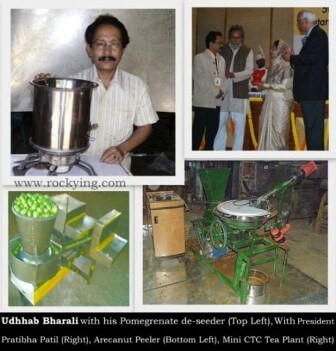
    Some of Bharali’s other inventions include: an arecanut peeling device, and the Cassava Peeler among others. The basic idea behind Bharali’s inventions was to reduce hours of back-breaking labour that farmers put in day and night; thus, making these inventions a hit with the farming community and those engaged in agricultural labour. In addition to these, he has also invented remi  recortication machine, garlic peeling machine, tobacco leaf cutter, paddy thresher, cane stripping machine, brass utensil polishing machine, safed musli peeling machine, and jatropha de-seeder. These inventions are popular abroad and local authorities like the Central Silk Board, North Eastern Region Community Resource Management Project and the National Innovation Foundation have helped Bharali to install these new machines. Bharali have recently developed a red cardamom dryer for the Spice Board of India, and a seed extractor for bananas for Institute of Advanced Study in Science and Technology.

    For a cause

    Despite his clients which consist of government bodies and research institutes, Bharali spends some of his time working for the betterment of the underprivileged. Keeping with this, he has started a shelter facility in his area, as well as a feeding programme. Bharali has also developed a number of machines for the differently-abled which helps them enhance their quality of life. Apart from being an innovator, he is a guest lecturer at a number of colleges and universities in Assam and all across India. A winner of many awards and recognitions, Bharali is far from retiring as his quest for knowledge and innovation is helping in bettering the society.

    -Dr Shobha Tawde

    Team ScienceNow Digital
  • Know Geology…

    Know Geology…

    Earth’s Interior

    Our mother Earth is formed around 2.5 billion years ago.

    The Earth was a hot ball of molten rocks at the time of her formation. She gradually cooled down

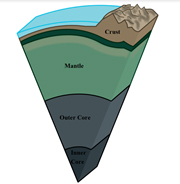
    from the surface inside, and currently is comprised of three distinct layers; the crust, mantle, and

    core. Let us understand each of the layer in detail.


    Crust: The Earth’s crust is the outermost layer of the Earth. Generally, the crust comprises

    of only first 100 km of the Earth’s interior. That is not even 2% of the total thickness of the

    Earth’s interior. But all the mining operations take place in this layer itself. This is because

    we do not yet possess the technology to drill deeper than even 15 km into the Earth’s interior

    (the deepest human interaction as of today is the Kola Superdeep Borehole, Russia (~12.3

    km)). This crust can be divided into two types; continental crust and oceanic crust. As the

    name suggests, the continental crust carries the continents, while the oceanic crust hosts

    oceans. The continental crust can be further divided in three layers. The first layer is 2 km

    thick, and is the lightest among them, with rock density approximately 2,200 kg/m 3 . This

    layer mainly comprises of sedimentary rocks. Important outtake from this layer is the soil we

    use for agriculture. The second layer goes up to 30 km depth, and comprises mainly of silica

    and alumina. Thus, this layer is also called as SIAL. Third layer reaches to boundary between

    the crust and the mantle, and mainly consists of silica and magnesia, earning it the name

    SIMA. Density of the rocks in this layer increases up to 2,800-3,000 kg/m 3 . This layer mainly

    comprises of igneous rocks.

    Mantle: The second layer, the mantle, starts under the crust, and extends up to 2,900 km

    depth. The boundary between crust and mantle is called ‘Mohorivicic Discontinuity’. The

    mantle can be divided into two regions; upper mantle and lower mantle. The boundary

    between the upper and lower mantle is located approximately at 700-800 km depth. The

    upper mantle can even further be divided into two layers, the first being the crazy one. This

    layer is called ‘Asthenosphere’. Asthenosphere means a layer of week particles. The

    asthenosphere is in the plastic state, instead of solid state. It means that the asthenosphere

    changes its shape according to the forces from the crust and mantle around it. Despite of the

    plastic state, the asthenosphere is able to bear the load of the crust. The reason behind this is

    the difference in densities. In the mantle, the density of rocks increases from 3,300 kg/m 3 in

    the beginning to 5,700 kg/m 3 in the end. Therefore, the lighter crust floats on the denser

    asthenosphere. The lower mantle is in the liquid state due to extreme heat. Mantle is also the region, where the subducted continental places arrive. Due to the heat and pressure, the plates

    melt, and are added to the Earth’s magma supply. This magma again reaches the Earth’s

    surface through volcanic eruptions and forms igneous rocks. Therefore, the mantle works as

    a furnace, where the utilized crust materials are recycled.


    Core: The Earth’s core begins at the end of the mantle, and extends up to the center of the

    Earth. Boundary between the mantle and the core is called ‘Gutenberg Discontinuity’. The

    core can be identified by the steep increase in the rock densities. The density of rocks, which

    was 5,700 kg/m 3 at the conclusion of the mantle, suddenly increases to 9,900 kg/m 3 . The

    density keeps increasing as we go even deeper, and it maxes out at 13,000 kg/m 3 at the center

    of the Earth. The core is made of iron and nickel, and the movement of iron and nickel

    particles in the core results in the formation of convection currents. These convection

    currents ultimately form the Earth’s magnetic field, or magnetosphere. The core can be

    divided into two regions; outer core and inner core. The outer core starts its regime from

    2,900 km depth, and extends up to 5,150 km depth. Inner core covers the rest of the thickness

    of the Earth’s interior. Inner core is in reality the hottest, but still in solid state, due to

    compressive pressure from surrounding crust, mantle and outer core.

    The difference in the rock densities throughout the Earth’s interior can be found by sudden

    change in the properties of seismic waves.


    -Ninad Bhagwat,

    Montana Tech University, USA

  • Mysteries Salt in the Dead Sea

    At 430.5 meters below sea level, the Dead Sea is the lowest spot on Earth. The Sea bordered by Israel and Jordan has 34.2% salinity, making it one of the saltiest bodies of water in the world. This mineral- rich water and mud of the Dead Sea are believed to have numerous benefits for the body, especially for skin, respiratory and arthritic conditions. For this reason, many people visit the Dead Sea every year to get special treatments at the spas surrounding it…

    Why ‘Dead’ Sea?

    The sea is called deadbecause its high salinity prevents macroscopic aquatic organisms, such as fish and aquatic plants, from living in it. In times of flood, the salt content of the Dead Sea can drop from its usual 35% to 30% or lower. Being 8.6 times saltier than the ocean, the Dead Sea is so salty that fish cannot swim in it, boats cannot sail on it, and animals cannot survive around it.

    The Salt in the Dead Sea

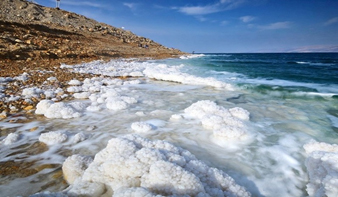
    People have visited the Dead Sea for thousands of years to experience its unique healing properties and to float in its dense, buoyant waters. Much of the freshwater feeding the Dead Sea has been diverted in recent decades, lowering the sea’s water levels and making it saltier than ever. Scientists first noticed in 1979, after this process had started, that salt crystals were precipitating out of the top layer of water, “snowing” down and piling up on the lake bed. The salt layer on the lake floor has been growing about 10 centimeters thicker every year.

    Do you know?

    Scientists believe that the Dead Sea will never disappear entirely. But by 2050 it will be the tipping point when the Sea will become so salty that the minerals will block water from evaporating, leaving a small pool of slimy sludge.

    A Salty Mystery

    As the Dead Sea has become saltier in recent decades, much of that salt has become concentratednear its surface. During the summer, extra heat from the sun warms the surface of the lake and divides it into a warm top layer sitting atop a colder lower layer. As water evaporates from the top layer in the summer heat, it becomes saltier than the cooler layer below. But then how was the salt from the surface building up at the bottom of the sea?

    A new study by scientists proposes that disturbances caused by waves or other motion create tiny “salt fingers” across the surface of the lake that interact with one another as they funnel down to the lake bed, forming larger structures.

    When the top layer of the lake is disturbed by waves or other motion, tiny parcels of warm water enter the cooler pool of water below. Heat diffuses more rapidly than salt, so this warm water parcel rapidly cools. As it cools, salt precipitates out and forms crystals that sink to the bottom. The researchers created a computer simulation of the salt fingers theory. And indeed, the theory correctly predicted the downward flow of salt snow and build up of salt layers in the middle of the lake’s floor.

    -Dr Siddhivinayak Barve

    Editor, ScienceNow Digital

  • BOOK REVIEW

    How Great Is Our God? The question is borderline between Science and Spirituality…

    The Book ‘100 Indescribable Devotions about God and Science’ brings out the compilation….

    Pastor Louie Giglio has compiled 100 more devotions that invite kids to explore the wonders of the universe, from the deadliest creature on Earth (the sea wasp jellyfish) to spider rain in Australia to the Earths trip around the sun.

    Written for elementary-age kids who are curious about the natural world and Gods role in it, the book: “How Great Is Our God – 100 Indescribable Devotions about God and Science” is packed with amazing scientific facts, beautiful photography, and fun illustrations by the same artist who illustrated Indescribable (Nicola Anderson), covering topics such as space and time, earth and weather, the human body animals, plants and more!

    -Team ScienceNow Digital

  • FILM REVIEW

    Ghostbusters : Afterlife

    Enjoy the suspense of the myth and reality screened very effectively in Ghostbusters…

    That’s right, folks, another Ghostbusters film! Only this time we are going back to the original 1980’s gang of Murray, Aykroyd, Hudson, and Weaver returning to their original roles. Joining the crew will be Paul Rudd and Stranger Things star Finn Wolfhard. The third Ghostbusters film has been in various stages of development since Ghostbuster II in 1989 and is now finally seeing the light of day released on July 10, 2020.

    Taking place thirty years after the events of the second movie, the plot follows a single mother and her two children who move to Summerville, Oklahoma after being evicted from their home and inherit property from their late grandfather, Egon Spengler. When the town experiences unexplained earthquakes; the children discover their link to the original Ghostbusters who have become something of a long-forgotten myth.

    -Team ScienceNow Digital

  •  

    Career Space Bound

    A career in aerospace engineering will see you working with cutting-edge technology in top-notch space agencies like ISRO, NASA, ESA and more…

    In simple terms, Aerospace Engineering is the study of the complex materials and structures that are put to use under atmospheric test such as aircrafts, spacecrafts, missiles and other airborne objects. And to manufacture all these and implement them you require highly trained engineers, scientists and technicians specializing in areas such as aerospace, aeronautics, electronics, computer science, robotics, chemistry, physics and meteorology. In short, Aerospace Engineers are engaged in high tech fields such as manufacturing of aircrafts for commercial or military use, space research and spacecraft production.

    Job Profile

    The primary job of an Aerospace Engineer is to design, create prototypes of these designs, and finally test them. The work may also involve evaluating designs of other engineers to make sure that the idea meets certain ethical, safety, and environmental standards. Overlooking building process as well, ensuring that proper deadlines are met is also part of work of an Aerospace Engineer. Typically, an Aerospace Engineers specializes in either aeronautical or astronautical design, which will determine whether they work with aircraft or spacecraft.

    Work Demands

    Using high-end computers and sophisticated programs, an Aerospace Engineer spends much time in an office setting. At times, you might find an Aerospace Engineer working in a manufacturing environment to oversee the construction and implementation of a design. Aerospace Engineers work full-time on regular basis. However, managing larger projects can require overtime hours, particularly when deadlines are approaching. Also working at the forefront of technology makes long career breaks difficult, as they need to keep up-todate with industry developments.

    Skills Above average intelligence

    • Excellent academic background
    • Responsible attitude
    • Ability to put in long work hours and days in crucial assignments
    • Good analytical ability
    • Scientific acumen
    • Ability to undertake challenging assignments

    Qualification

    Students who want to build their career as Aeronautic Engineers are advised to prepare for the career path well in advance by focusing on science and mathematics in high school. Students who have successfully completed 12th or equivalent with PCM/ PCB are eligible to apply for the entrance exam for Aeronautical Engineering for B. Tech. course. The minimum percentage required for it is 60% for most of the entrance examinations. They could also go in for post graduate and doctoral studies in the particular field of interest.

    Institutions offering courses Aeronautical Engineering

    • Indian Institute of Aeronautical Engineering, Dehradun
    • Indian Institute for Aeronautical Engineering and Information Technology, Pune
    • Manipal Institute of Technology, Manipal
    • Rajasthan Institute of Technology and Engineering Science, Kota
    • The Indian Institute of Science, Bangalore


    Future Prospects

    Mostly Aeronautical Engineers get jobs at automobile or power companies, where the principles of turbines or engines come into play. Companies like BHEL, L& T, Tata Power etc. can hire aeronautical engineers. But yes, if you’re seeking purely aerospace jobs, then try to apply at ISRO, which is one of the worlds top space agencies. You can also seek jobs at DRDO (makes missiles and fighter jets), Hindustan Aeronautics Limited (HAL) or National Aeronautics Limited (NAL). However, bagging a job at either ISRO or DRDO is extremely competitive because the positions are few and there would be many applicants.

    -Team ScienceNow Digital


  • The Space Junk

    The Space Junk

    According to the latest report, there are more than 200 million pieces of debris orbiting around the Earth, putting our working satellites at risk…

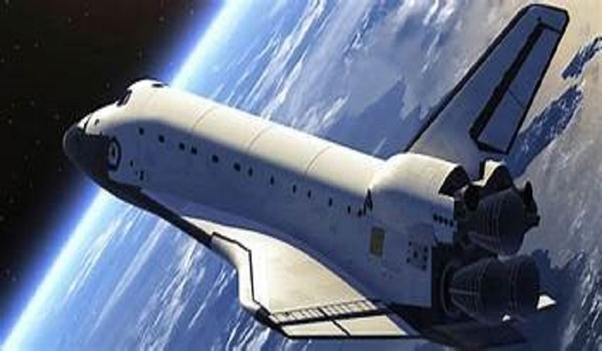
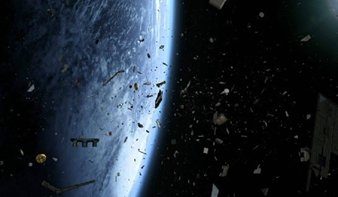
    At present there are hundreds of man-made objects circulating our planet Earth. These objects which move at a speed of over 22,300 mph, faster than a speeding bullet can put our working satellites in grave danger. And these small fragments can leave huge dents in several satellites, telescopes, and other objects orbiting our planet. In 2006, for instance, a tiny piece of space debris collided with the ISS, creating a big dent in a heavily reinforced window.

    There are more than 125 million pieces of debris smaller than 1 cm, about 900,000 pieces of debris 1–10 cm, and around 34,000 of pieces larger than 10 cm were estimated to be in orbit around the Earth. Most of these debris float within 1,250 miles of Earth's surface in what is known as low Earth orbit, home to a number of satellites, such as NASA’s Earth Observing System fleet and the International Space Station (ISS). And while space is big, this space junk can be problematic for active earth satellites because of their swift speeds.

    What is this space junk?

    Space debris began to amass in Earth’s orbit immediately with the first launch of an artificial satellite (Sputnik 1) into orbit in 1957. Immediately after that the North American Aerospace Defense Command (NORAD) began compiling a database of all known rocket launches and objects reaching orbit: satellites, protective shields and upper- and lower-stage booster rockets. Although it heralded a new beginning in the Space Age, with over 8,900 satellites from more than 40 countries launched so far, it left a mark in space in the form of junk.

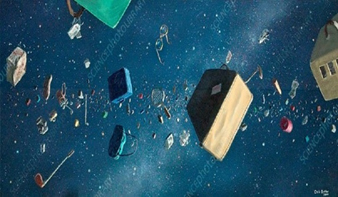
    And this space junk mostly comprises of stages from rockets that put satellites into orbit and satellites itself after it becomes dysfunctional. In addition, it includes small pieces of junk lost to space which includes nuts and bolts, screwdriver, garbage bags and more. But the number has increased significantly recently with China and India testing their anti-satellite missile, creating at least 400 pieces of debris, which have further increased the risk of impacts to the ISS and other satellites orbiting the space.

    With our skies becoming overcrowded with scientific and commercial satellites, it is high time countries need to work towards curbing the growing problem.

    Cause for Concern?

    There is all possibility that some of the junk will lose altitude over time and burn up in the Earth’s atmosphere. Despite this, there is still a lot of junk up there. Even without launching new satellites or major explosions, the space debris in Earth’s low orbit is so huge that it will continue to create problem over the centuries.

    Reports suggest that over the next 200 years or so, debris larger than about 8 inches will increase by 1.5 times. And smaller trash will increase even more! Junk between 4 inches and 8 inches is expected to multiply 3.2 times and debris less than 4 inches will grow by a factor of 13 to 20. And this is likely to increase in future as more space programs have already been planned by various nations.

    Precautions

    Although many space agencies and private space firms have come out with various concepts, it still seems to be a distant dream. For example: JAXA, Japans space agency, is testing an electronic space whip that stretches six football fields long, known as the electrodynamic tether (EDT). The electrified line, nearly 2,300 feet long, is capped with a 44-pound weight. When deployed, it is intended to knock debris out of orbit, sending it to burn up in Earths atmosphere. Other options include giant magnets, harpoons, and nets to safely cut down the growing debris cloud.

    Many countries are also developing plans to ensure that any future man-made satellites sent into space have an appropriate “end-of-life plan” to stop the growing menace of debris that float above our planet.

    Manoj Mahanta

    -Team ScienceNow Digital

  • Believe it or Not!

    Believe it or Not but it is true…

    -Sunglasses were invented by the Chinese as a way for judges to hide their emotions in the courtroom!

    -Molecular Biology Prof. Rany Lewis transplanted spider DNA into goats that allows them to` produce milk with an extra protein than can be extracted and spun into spider silk!

    -The CIA uses board games to train its officers!

    -With a melting point of 85-degree Fahrenheit, you can turn a solid cube of Gallium into a liquid just by holding it in your hand!

    -During Earthquakes, water vaporizes inside faults turning it into gold!

    -Located in the Sahara Desert, the worlds longest conveyor belt system is 98 kilometres long – and can be seen from space!

    -Gorillas can catch colds from humans!

    -Consuming an excessive amount of water in a short period of time can lead to Hyponatremia or -water intoxication!

    -After examining samples of a 15,000-year-old Tibetan glacier collected in 1992 and 2015,  scientists discovered 28 never before seen virus groups!

    -The venom from a Golden Lance head bite is so potent that its capable of melting human flesh!

    -Team ScienceNow Digital

  • Do you know?

    Do you know?

    The incredible facts for you…

    Why is DIAMOND the hardest substance on Earth?

    Diamonds are incredibly hard because they have crystallized in a particular atomic shape after being subject to the effect of heat and pressure on Earth at a depth of 140 to 150 kilometres. This makes diamond the hardest mineral on earth and cannot be broken or cut easily. It is only possible by using another diamond.


    Why do NEWSPAPERS turn yellow over time?

    Paper is made from wood, which is made up mainly of white cellulose. Wood also has a lot of a dark substance in it called lignin, which ends up in the paper, too, along with the cellulose. The exposure of lignin to air and sunlight is what turns paper yellow.


    Why do we get HEATSTROKE?

    Heatstroke is a condition caused by your body overheating, usually as a result of prolonged exposure to or physical exertion in high temperatures. This most serious form of heat injury – heatstroke, can occur if your body temperature rises to 104 F (40 C) or higher.


    Why do FORMULA 1 driver lose weight?

    The F1 drivers can lose up to three kgs weight after a race due to extreme heat in the cockpit of the vehicle. Hence, the drivers take in large amounts of water before the race, even if they do not feel thirsty, to avoid dehydration through sweating.


    Why is SUN harsh in summer?

    In the early morning and late evening, UV (ultraviolet) radiation is less strong because the rays have farther to travel to get to the Earth. But throughout the year, the suns angle varies with the seasons, so the strength of UV rays change, too. UV rays are strongest in the summer months.

    -Team ScienceNow

  • RIDDLES

    Relax and Enjoy with witty Riddles…

    What is neither water nor land, and is always soaking wet?
    Wetlands

    Which two periodic elements, when combined, heal?
    Helium and Aluminium (HE + AL)

    Which four periodic elements, when combined, make up something that terrifies criminals?
    Carbon, Oxygen, Phosphorous and Sulphur (C+O+P+S)

    I can rush, I can be still, I can be hot, I can be cold, I can be hard, I can slip through almost
    anything. What am I?
    Water

    It is impossible for me to be created, and I can never be destroyed, I can only change form. What
    am I?
    Energy

    -Team ScienceNow Digital